Key Takeaways
- Every missed estrus cycle costs $500–$800 in delayed conception — visual observation catches only 50–60% of heats, meaning 40–50% of breeding opportunities are invisible losses
- Capital purchase systems require $50,000–$150,000 upfront for a 500-head operation, with additional ongoing costs for maintenance, software licensing, and hardware replacement that are often underestimated
- Subscription models deliver positive ROI from month one because the monthly per-head cost is immediately offset by the value of detected heats — no 18–36 month payback period required
- Over a 5-year period, subscription total cost of ownership is 15–30% lower than capital purchase when accounting for hardware obsolescence, battery replacement labor, and software upgrade fees
- Capital purchase only makes economic sense for very large operations (5,000+ head) with dedicated IT staff and access to low-cost financing — for most commercial herds, subscription wins
Automated estrus detection is no longer a question of whether it works — the technology consistently delivers 90–95% detection accuracy compared to visual observation's 50–60%. The real question facing livestock producers today is how to acquire it. Should you buy a system outright or subscribe to a monitoring service? The answer depends on your herd size, financial structure, and tolerance for technology risk — but the numbers tell a clear story for most operations.
This article provides a transparent, line-item cost comparison between capital purchase and subscription models for automated heat detection, using real-world pricing and operational data across three common herd sizes. The goal is to give producers and financial managers the numbers they need to make an informed procurement decision.
The Real Cost of Estrus Detection Failure
Before comparing acquisition models, it is essential to understand what is at stake. Every undetected estrus event is a missed breeding opportunity that extends the calving interval by 21 days — one full cycle. The economic impact of that delay is well documented and substantial.
For dairy operations, each missed heat costs $500–$800 when accounting for additional feed days during the extended open period, reduced lifetime milk yield due to suboptimal calving intervals, delayed calf revenue, and increased probability of involuntary culling for reproductive failure. For beef-breeding herds, the impact is similarly severe — a missed cycle means a calf born 21 days later, lighter at weaning, and potentially falling outside the optimal marketing window.
The math is straightforward. A 500-head dairy operation with visual observation detecting 55% of heats will miss approximately 900 estrus events per year (assuming 4 cycles per cow before conception). At a conservative $300 average impact per missed cycle, the annual invisible loss exceeds $100,000. This is the baseline cost that any automated detection system — whether purchased or subscribed — must be measured against.
The question is not whether automated detection pays for itself. It does. The question is which acquisition model delivers the best return with the least risk.
Capital Purchase Model: What You're Actually Buying
The traditional approach to acquiring automated heat detection is a capital purchase — buying hardware, software licenses, and installation services outright. This model has been the industry standard for decades, and it appeals to producers who prefer to own their equipment and avoid recurring fees.
However, the headline purchase price significantly understates the true cost of ownership. Here is what a capital purchase actually entails for a mid-size operation:
Upfront Hardware and Installation
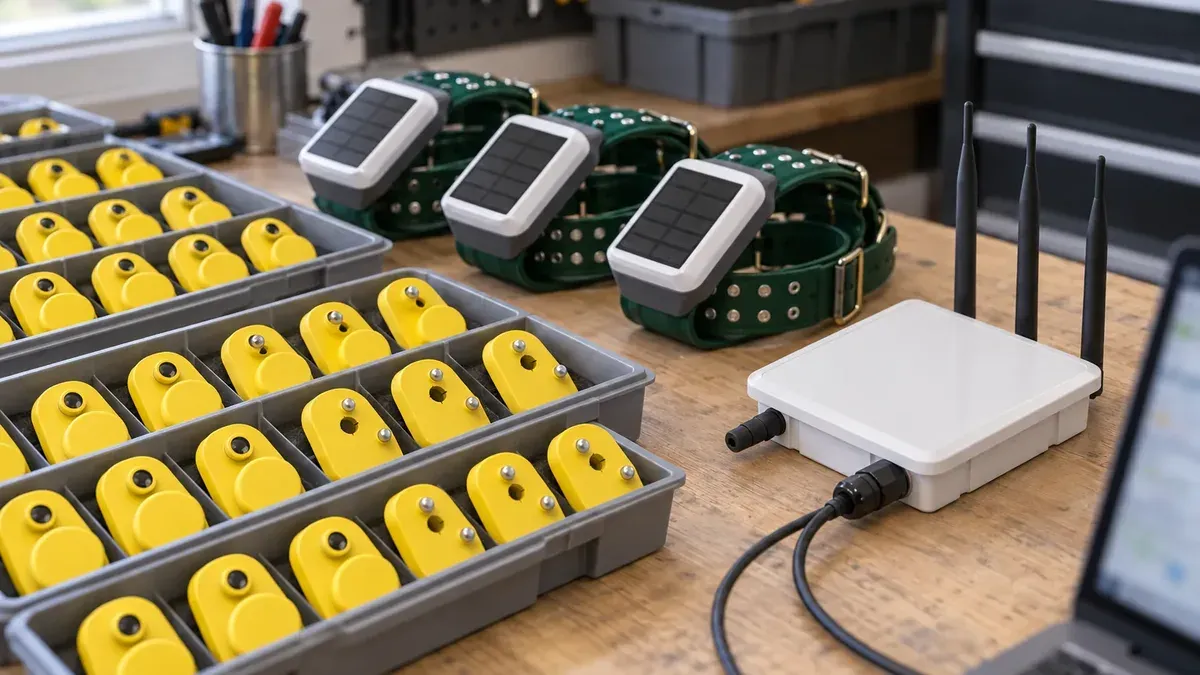
A complete automated detection system for a 500-head operation typically includes sensor devices (eartags, collars, or boluses, depending on the vendor) for each animal, one or more base stations or gateways, network infrastructure (antennas, cabling, mounting hardware), and server or cloud computing resources for data processing. The combined upfront cost ranges from $50,000 to $150,000, depending on the technology platform, sensor type, and infrastructure requirements.
Installation is a separate cost center. Professional installation typically runs $5,000–$15,000 for gateway placement, network commissioning, and initial animal tagging. Operations in remote locations or with complex facility layouts may face higher installation costs due to the need for additional gateways or signal repeaters.
Ongoing Costs That Don't Appear in the Quote
The purchase price is only the beginning. Capital-purchased systems carry several ongoing costs that are frequently underestimated during the procurement process:
- Software licensing — Most systems require an annual software license or cloud data fee of $3,000–$8,000 per year. This is often presented as optional during the sales process but is functionally mandatory, as the hardware is inoperable without the analytics platform
- Battery replacement — Eartag batteries last 3–5 years depending on transmission frequency. Replacing batteries or entire tags across a 500-head herd costs $10,000–$25,000 per replacement cycle, plus the labor of gathering and re-tagging every animal
- Hardware attrition — Tags are lost, damaged by animals, or fail. Industry attrition rates run 5–10% annually, costing $2,500–$7,500 per year in replacement hardware
- Maintenance and support — Gateway hardware requires periodic maintenance, firmware updates, and occasional replacement. Extended warranty or support contracts add $2,000–$5,000 per year
- Technology obsolescence — Sensor technology, wireless protocols, and machine learning algorithms evolve rapidly. A system purchased today may be functionally outdated within 3–5 years, requiring a full replacement cycle to access current capabilities
Subscription Model: What's Different
The subscription model — sometimes called Hardware-as-a-Service or Monitoring-as-a-Service — takes a fundamentally different approach. Instead of purchasing equipment, the operation pays a monthly per-head fee that includes everything: hardware deployment, software access, hardware replacement, maintenance, support, and technology upgrades.
Here is what a subscription model typically provides:
- Zero upfront capital — No hardware purchase, no installation fees, no initial software licensing. The provider deploys and commissions the system as part of the subscription
- All-inclusive monthly fee — A single per-animal monthly cost covers sensor hardware, gateway infrastructure, cloud analytics, mobile alerts, and technical support
- Hardware replacement included — Lost, damaged, or failed tags are replaced at no additional cost. Herdwize ear tags run 2–4 years on a button cell, sized to outlast the animal's time on the tag, so no battery replacement is needed — tags are replaced only when animals turn over
- Always-current technology — As the provider upgrades sensors, algorithms, or platform capabilities, subscribers receive those improvements without additional cost or disruption
- Flexible scaling — Add animals during expansion, reduce during herd contraction. The cost scales linearly with herd size rather than requiring step-function hardware purchases
- Performance accountability — Subscription providers have a direct financial incentive to ensure the system works, because cancellation means lost recurring revenue. Capital purchase vendors have less incentive to support a system after the sale is complete
5-Year Total Cost Comparison
The following table compares the total cost of ownership over a 5-year period for capital purchase versus subscription across three common herd sizes. All figures use mid-range industry pricing and include every cost category — not just the headline purchase price.
| Cost Category | 200 Head (CAPEX) | 200 Head (Sub.) | 500 Head (CAPEX) | 500 Head (Sub.) | 1,000 Head (CAPEX) | 1,000 Head (Sub.) |
|---|---|---|---|---|---|---|
| Hardware purchase | $28,000 | $0 | $65,000 | $0 | $120,000 | $0 |
| Installation | $5,000 | $0 | $10,000 | $0 | $15,000 | $0 |
| Software licensing (5 yr) | $15,000 | Included | $25,000 | Included | $40,000 | Included |
| Battery/tag replacement | $8,000 | Included | $18,000 | Included | $32,000 | Included |
| Hardware attrition (5 yr) | $7,000 | Included | $16,000 | Included | $30,000 | Included |
| Support/maintenance (5 yr) | $10,000 | Included | $18,000 | Included | $25,000 | Included |
| Subscription cost (5 yr) | N/A | $60,000 | N/A | $120,000 | N/A | $210,000 |
| 5-Year Total | $73,000 | $60,000 | $152,000 | $120,000 | $262,000 | $210,000 |
At every herd size in this analysis, the subscription model delivers a lower 5-year total cost of ownership — 18% lower for 200-head, 21% lower for 500-head, and 20% lower for 1,000-head operations. And this comparison does not yet account for the single largest hidden cost of capital purchase: technology obsolescence.
Hidden Costs of Capital Purchase
The 5-year cost comparison above captures the quantifiable expenses, but several additional capital purchase risks are difficult to price in advance yet have significant financial impact.
Technology Obsolescence
Livestock monitoring technology is evolving rapidly. Sensor capabilities, wireless protocols, and machine learning algorithms improve substantially every 3–5 years. A system purchased in 2024 may lack multi-sensor fusion, edge computing, or advanced behavioral analytics that become standard by 2027. Capital purchase locks you into the technology available at the time of purchase, with no economically viable upgrade path short of buying a new system.
Consider the trajectory: early pedometer-based systems measured only step count and relied on simple thresholds. Later tags added motion and feeding behavior estimates. Current platforms pair activity data with body temperature sensing and machine learning on individual baselines. An operation that purchased an activity-only pedometer system in 2019 now has hardware that is functionally obsolete — still operational but delivering 70–80% accuracy compared to the 92% achievable with current multi-sensor platforms.
Battery Replacement Labor
The cost of replacement batteries or tags is quantifiable, but the labor cost of gathering and re-tagging 500+ animals is frequently overlooked. Depending on facility design and animal handling infrastructure, re-tagging a full herd requires 2–4 days of labor involving multiple staff members, cattle handling stress, and production disruption. At $25/hour for 3 staff over 3 days, the labor alone adds $1,800 per replacement cycle — on top of the hardware cost.
Software Licensing Escalation
Annual software fees for capital-purchased systems tend to increase over time. Vendors know that once hardware is purchased, the operation is locked into their software platform and has limited negotiating leverage. Industry reports show software licensing fees increasing 5–10% annually, meaning a $5,000/year license becomes $6,400–$8,000/year by year five. Subscription pricing, by contrast, is typically locked for the contract term with any increases subject to competitive market pressure.
No Performance Guarantees
When you purchase hardware outright, the vendor's obligation ends at delivery. If the system underperforms, detection accuracy is lower than claimed, or hardware failure rates exceed expectations, the financial risk falls entirely on the operation. Subscription providers, by contrast, must deliver ongoing value to retain the account — creating a natural alignment of incentives that is absent in the capital purchase model.
When Capital Purchase Makes Sense
Despite the subscription model's advantages for most operations, there are specific scenarios where capital purchase remains the better economic choice:
Very Large Operations (5,000+ Head)
At very large scale, the per-head economics of capital purchase improve significantly because infrastructure costs (gateways, network equipment, installation) are spread across more animals. A 5,000-head operation might spend $300,000 on hardware and infrastructure — $60 per head — compared to a subscription cost of $5–$8/head/month ($300–$480/head over 5 years). At this scale, capital purchase can deliver a 30–40% cost advantage over the subscription term, provided the operation can manage maintenance and replacement internally.
Operations with Existing IT Infrastructure
Operations that already maintain dedicated IT staff, network infrastructure, and data management systems can absorb the ongoing maintenance burden of a purchased system without incremental staffing costs. These operations can also handle firmware updates, gateway troubleshooting, and system integration internally, eliminating the support premium built into subscription pricing.
Access to Very Low-Cost Financing
When equipment financing is available at rates below 3–4% (through agricultural development programs, manufacturer financing, or favorable bank terms), the cost of capital on a purchased system is minimal. Combined with accelerated depreciation tax benefits, low-rate financing can make the effective cost of capital purchase competitive with subscription even at moderate herd sizes.
When Subscription Makes Sense
For the majority of commercial livestock operations, subscription-based monitoring is the economically superior choice. The following scenarios strongly favor subscription:
Most Commercial Operations (200–3,000 Head)
This is the core market where subscription economics are most compelling. The operation is large enough to generate meaningful value from automated detection but not large enough to justify the infrastructure investment, IT staffing, and maintenance burden of a purchased system. The subscription model provides enterprise-grade monitoring capability without enterprise-scale overhead.
Operations Without Dedicated IT Staff
If your operation does not have a staff member whose job includes managing technology infrastructure, a purchased system will require either hiring that capability or relying on external support — both of which add cost and complexity. Subscription monitoring is fully managed: deployment, maintenance, troubleshooting, and upgrades are handled by the provider.
Producers Wanting Predictable Operating Costs
Farm financial management benefits from predictable cash flow. A subscription converts an unpredictable pattern of capital outlays, repair costs, and replacement expenses into a single, fixed monthly operating cost that can be budgeted accurately and deducted as a current-year business expense.
Operations Wanting to Try Before Scaling
Subscription models allow producers to deploy monitoring on a portion of the herd — a single barn, a high-value breeding group, or a specific management challenge — and evaluate results before committing to full-herd deployment. This is impossible with capital purchase, where the upfront investment requires a full-scale commitment before any results are available.
Impact on ROI Timeline
The acquisition model has a profound impact on when an operation begins generating positive return from automated detection. This difference is often the most important factor in the procurement decision, yet it receives less attention than the total cost comparison.
Subscription: Positive ROI from Month One
With a subscription model, the monthly cost for a 500-head operation is approximately $2,000–$3,000. The value of improved estrus detection — even in the first month of operation, before the system has fully calibrated individual animal baselines — typically exceeds $8,000–$15,000 per month in detected heats that would have been missed by visual observation. The net return is positive from the first month, and every subsequent month adds to the cumulative gain.
Capital Purchase: 18–36 Month Payback
A capital purchase requires the operation to first recover the upfront investment before any net positive return is realized. For a 500-head operation spending $65,000–$100,000 on hardware and installation, the payback period — even with strong detection performance — typically runs 18–36 months. During this entire period, the operation has invested capital, assumed technology risk, and committed to a specific vendor platform without yet achieving break-even.
This timeline difference matters beyond the financial calculation. A subscription that delivers positive ROI from day one is easy to justify internally and easy to expand. A capital purchase that requires 2–3 years of patience before break-even faces ongoing scrutiny from ownership and financial management, particularly if market conditions change or the operation encounters cash flow pressure during the payback period.
Making the Decision: A Framework
The choice between subscription and capital purchase ultimately comes down to four factors:
- Herd size — Below 3,000 head, subscription is almost always the better economic choice. Above 5,000 head, capital purchase begins to offer meaningful cost advantages. Between 3,000 and 5,000, the decision depends on the other three factors
- IT capability — If you have dedicated technology staff, capital purchase is viable. If not, subscription eliminates a significant management burden
- Cash flow preference — If you prefer to preserve working capital and want predictable monthly expenses, subscription is the clear choice. If you have access to low-cost financing and prefer to own assets, capital purchase may appeal
- Technology risk tolerance — If you are comfortable committing to a specific technology platform for 5+ years, capital purchase is acceptable. If you want the flexibility to benefit from continuous technology improvement, subscription provides that without additional cost
For the majority of commercial dairy, beef, and breeding operations in North America, the subscription model delivers lower total cost, faster ROI, less risk, and more flexibility. The capital purchase model retains advantages only at very large scale or for operations with existing technology infrastructure and low-cost financing.
Conclusion
The cost of missed estrus events is real, measurable, and significant — exceeding $100,000 annually for mid-size operations relying on visual observation. Automated detection technology eliminates the majority of these losses, but the method of acquiring that technology matters almost as much as the technology itself.
Capital purchase front-loads cost, locks in technology, and requires 18–36 months to break even. Subscription eliminates the upfront barrier, delivers positive ROI from the first month, includes all maintenance and replacement, and ensures access to current technology. Over a 5-year period, subscription total cost of ownership is 15–30% lower for operations under 3,000 head.
The economics are clear: for most commercial livestock operations, subscription-based automated heat detection is the financially superior choice. The remaining question is not whether to automate estrus detection, but how quickly you can deploy it and begin recovering the value of those missed heats.
Calculate Your Detection Cost Savings
Get a customized subscription vs. purchase comparison based on your herd size, operation type, and current detection methods.
Request a Cost Analysis