Key Takeaways
- Feed represents 55-70% of total cattle production costs, making it the single largest expense in every operation type
- Daily cattle feed costs range from $1.50-$2.50 for cow-calf to $3.00-$5.50 for feedlot operations, with dairy cows averaging $6.00-$9.00 per head per day
- Seasonal feed price swings can increase costs by 25-40% during winter months compared to summer grazing periods
- Producers using feed efficiency and behavior monitoring technology report 8-15% reductions in feed waste, translating to $0.15-$0.40 per head per day in savings
- Improving feed conversion ratio by just 0.5 points saves $25-$50 per head over a typical 150-day feedlot finishing period
Understanding cattle feed cost is the foundation of profitable livestock production. Whether you run a 200-head cow-calf operation, a 5,000-head feedlot, or a 500-cow dairy, feed is your largest single expense — typically consuming 55-70% of total production costs. When corn prices shift by $1 per bushel or hay prices spike after a drought, the impact ripples through every line of your budget. Yet many producers lack a detailed, data-driven understanding of exactly where their feed dollars go, how much waste occurs between the mixer and the rumen, and which animals are converting efficiently versus which are silently eroding margins.
This guide breaks down cattle feed costs across every major operation type, examines the seasonal and market forces that drive price volatility, and provides the metrics and strategies producers need to build accurate feed budgets. We also explore how modern monitoring technology is giving producers real-time visibility into feed efficiency — turning the industry's largest expense from a black box into a manageable, optimizable cost center.
Breaking Down Cattle Feed Costs
Cattle feed cost is not a single number — it varies dramatically based on operation type, geography, ingredient sourcing, and management practices. To build an accurate feed budget, producers need to understand costs at three levels: per ton (ingredient purchasing), per head per day (daily operating cost), and per head annually (strategic budgeting).
Feed Cost per Ton
Feed ingredients are purchased by the ton, and prices fluctuate with commodity markets, transportation costs, and regional availability. Here are typical price ranges for common cattle feed ingredients as of recent market conditions:
| Feed Ingredient | Price per Ton | Protein (CP%) | Energy (TDN%) |
|---|---|---|---|
| Corn (shelled) | $180-$260 | 8-9% | 88-90% |
| Soybean meal | $350-$480 | 44-48% | 78-82% |
| Distillers grains (wet) | $80-$140 | 30-33% | 85-90% |
| Alfalfa hay (premium) | $200-$350 | 18-22% | 58-62% |
| Grass hay (good quality) | $120-$220 | 8-12% | 52-58% |
| Corn silage | $35-$55 | 7-9% | 65-72% |
| Complete feedlot TMR | $280-$420 | 12-14% | 72-78% |
| Mineral/vitamin premix | $800-$1,400 | Varies | N/A |
These per-ton prices are the starting point for calculating cattle feed cost, but they tell only part of the story. Transportation adds $15-$40 per ton depending on distance from the source, and shrink during storage and handling can add another 3-8% to effective cost. The true delivered cost of feed often exceeds the purchase price by 10-20% once logistics and waste are factored in.
Feed Cost per Head per Day
Daily feed cost per head is the metric most producers track for day-to-day management. This figure combines ingredient cost, daily intake (measured in pounds of dry matter), and any supplements, minerals, or feed additives included in the ration. A 1,300-pound feedlot steer consuming 28 pounds of dry matter per day from a TMR priced at $350 per ton has a daily feed cost of approximately $4.90. A 1,200-pound cow on winter hay at $180 per ton consuming 26 pounds of dry matter costs approximately $2.34 per day in feed alone.
These per-head daily costs compound quickly across a herd. A 500-head feedlot spending $4.50 per head per day generates a daily feed bill of $2,250 — or $67,500 per month. A 300-cow operation spending $2.00 per head per day during a five-month winter feeding period accumulates $90,000 in feed costs before the first calf hits the ground. Understanding these numbers at a granular level is what separates producers who manage margins from those who discover them after the fact.
Feed Cost by Operation Type
Cattle feed costs differ substantially across operation types because each system has different nutritional requirements, feeding durations, and management objectives. A cow-calf producer is maintaining body condition on mature cows through low-cost forages. A feedlot operator is maximizing gain with energy-dense rations. A dairy producer is fueling milk production with high-protein, high-energy diets. The following comparison table shows typical daily and annual feed costs across these three major operation types.
| Metric | Cow-Calf | Feedlot | Dairy |
|---|---|---|---|
| Daily feed cost/head | $1.50-$2.50 | $3.00-$5.50 | $6.00-$9.00 |
| DM intake (lbs/day) | 24-28 | 22-30 | 45-60 |
| Feeding period | 120-180 days | 120-200 days | 365 days |
| Annual feed cost/head | $550-$900 | $450-$825* | $2,200-$3,300 |
| Primary ration base | Hay/pasture | Corn/silage TMR | TMR with bypass protein |
| Feed as % of total cost | 55-65% | 65-75% | 50-60% |
*Feedlot annual cost reflects a single finishing period, not year-round feeding. Cost per head per turn is $450-$825 depending on days on feed and ration cost.
Cow-Calf Operations
Cow-calf producers face the longest feeding obligation relative to revenue — maintaining a mature cow year-round to produce one calf valued at $800-$1,200 at weaning. Feed costs in cow-calf systems are dominated by winter hay and supplementation during the 120-180 days when pasture is unavailable. Summer grazing costs are dramatically lower — often $0.30-$0.75 per head per day for managed pasture — but winter feed costs of $1.80-$2.50 per head per day represent the make-or-break period for profitability. The total annual feed cost per cow, including summer pasture, winter hay, mineral supplementation, and any creep feed for calves, typically lands between $550 and $900 depending on geography and forage costs.
Feedlot Operations
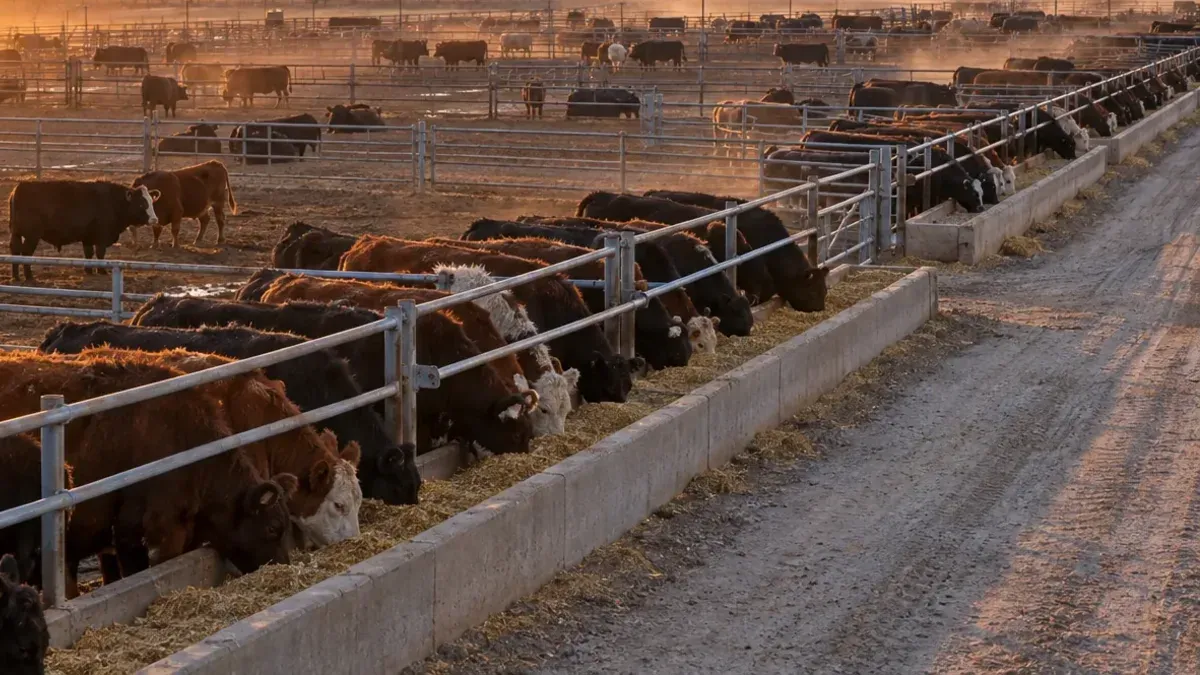
Feedlot cattle feed cost per head per day runs higher than cow-calf because finishing rations are energy-dense and ingredient costs per ton are significantly above hay prices. A typical feedlot ration containing corn, distillers grains, corn silage, and supplement costs $300-$420 per ton as a complete mixed ration. At 24-30 pounds of dry matter intake per day, that translates to $3.00-$5.50 per head daily. Over a 150-day finishing period, total feed cost per head ranges from $450 to $825. The critical metric in feedlot economics is not total feed cost but feed conversion ratio — how many pounds of feed it takes to produce one pound of gain. A steer converting at 5.5:1 is dramatically more profitable than one converting at 7.0:1, even if both consume the same daily ration cost.
Dairy Operations
Dairy cattle have the highest daily feed cost of any cattle operation because high-producing cows require energy-dense, high-protein diets to sustain milk production of 70-100 pounds per day. A lactating Holstein consuming 55 pounds of dry matter from a TMR with bypass protein, energy supplements, and forage has a daily feed cost of $6.00-$9.00. However, dairy feed economics differ from beef in one critical way: the revenue feedback loop is daily. Milk checks arrive every two weeks, creating an immediate and measurable connection between feed cost, milk output, and income over feed cost (IOFC). This tight feedback loop makes dairy producers more attuned to feed cost per hundredweight of milk than any other metric — and it is where feed efficiency monitoring delivers the fastest measurable return.
Seasonal Feed Cost Variations
Cattle feed costs are not static. They fluctuate with seasons, commodity markets, weather events, and global trade patterns. Understanding these cycles is essential for feed budgeting and purchasing strategy.
Winter: The Expensive Season
Winter is the most expensive feeding period for the majority of North American cattle operations. When pasture goes dormant, producers must supply 100% of the animal's nutritional needs through harvested forages, purchased hay, and supplements. This shift from grazed forage to delivered feed increases daily cost per head by 25-40% compared to summer. For a 500-cow operation, the transition from summer grazing at $0.50 per head per day to winter feeding at $2.20 per head per day adds approximately $127,500 in feed costs over a 150-day winter period. Hay availability and local market conditions can amplify this further — drought years have pushed hay prices to $300-$400 per ton in affected regions, doubling normal winter feed costs.
Spring and Fall: Transition Periods
Spring and fall present their own feed cost challenges. Spring turnout onto fresh pasture reduces daily cost but requires careful management of grass tetany risk and body condition recovery after winter. Fall brings the decision point of whether to background calves on farm or sell at weaning, with feed cost projections for the backgrounding period determining the economic answer. Corn and soybean harvest in fall typically provides a seasonal price dip for grain-based feeds, creating a purchasing window for feedlot operators and dairy producers. Producers who forward-contract or purchase storage capacity during these windows can reduce annual feed costs by 5-12%.
Commodity Market Volatility
Beyond seasonal patterns, cattle feed cost is exposed to global commodity markets. Corn prices — the foundation of feedlot and dairy rations — have ranged from $3.50 to $8.00 per bushel over the past decade, a swing that translates to roughly $70-$160 per ton variation in the primary energy source. Soybean meal has shown similar volatility. A $100 per ton increase in soybean meal price adds approximately $0.30-$0.50 per head per day in dairy and feedlot rations. Ethanol policy, export demand, weather events in major growing regions, and transportation disruptions all contribute to price uncertainty. The producers who manage feed cost most effectively are those who combine forward purchasing strategies with real-time monitoring of feed efficiency — ensuring that every dollar spent on feed delivers maximum productive value.
Factors That Drive Feed Costs Up
Beyond ingredient prices and market forces, several operational factors inflate feed costs above what they should be. These are controllable variables — and they represent the largest opportunity for cost reduction through better management and technology adoption.
Feed Waste and Bunk Management Errors
Feed waste is the most underestimated cost driver in cattle operations. Industry research consistently shows that 5-15% of delivered feed never reaches the rumen. Bunk overfeeding — delivering more feed than cattle will consume before the next feeding — results in spoiled, stale feed that animals refuse. Underfeeding creates competition and uneven intake distribution. Poor bunk design allows wind, rain, and wildlife to degrade feed quality. In a feedlot spending $4.50 per head per day, a 10% waste rate represents $0.45 per head per day in feed that generates zero productive return — or $67.50 per head over a 150-day feeding period. Across a 2,000-head feedlot, that totals $135,000 in annual waste.
Poor Feed Storage
Storage losses compound purchasing costs in ways that often go unmeasured. Hay stored outside without cover loses 15-35% of dry matter and nutritive value through weathering. Silage bunkers with poor packing density or inadequate cover lose 10-20% of stored tonnage to spoilage on the face and top. Grain bins with moisture problems develop mold that reduces palatability and can cause mycotoxin contamination, leading to both feed refusal and health issues. These storage losses effectively increase the per-ton cost of feed by the percentage lost — a $200 per ton hay that loses 25% in outdoor storage has an effective cost of $267 per ton for the usable portion.
Overcrowding and Social Stress
When cattle are overcrowded at the feed bunk, dominant animals consume more than their share while subordinate animals are displaced, eat less, and exhibit reduced feed efficiency. Research has shown that feedlot cattle with inadequate bunk space (less than 12 inches per head) have 3-7% lower average daily gain and 5-10% worse feed conversion compared to cattle with adequate space. In dairy operations, overcrowding at the feed rail reduces lying time, increases cortisol levels, and depresses both dry matter intake and milk production. The cost of overcrowding is invisible on any single day but compounds into significant economic loss over weeks and months.
Health Problems and Off-Feed Events
Sick cattle do not eat. An animal experiencing bovine respiratory disease (BRD), acidosis, or other illness reduces feed intake by 30-70% during the acute phase and may take 7-14 days to return to normal consumption after recovery. During this period, the animal continues to occupy pen space, require labor and veterinary attention, and accrue fixed costs — while contributing nothing to production. In feedlot settings, a single BRD case costs $50-$150 in treatment plus $75-$200 in lost performance (reduced gain and worse feed conversion during recovery). Subclinical illness is even more insidious — animals that are mildly ill but never pulled for treatment show 5-15% reduced feed efficiency that remains invisible without individual monitoring. This is where feed efficiency monitoring technology delivers its greatest value.
Lack of Feed Efficiency Data
Perhaps the most fundamental cost driver is simply not knowing. Without individual or pen-level data on feed consumption patterns, rumination activity, and conversion efficiency, producers cannot identify which animals or groups are underperforming. They cannot detect the early stages of digestive upset before it becomes clinical illness. They cannot optimize bunk management timing or ration adjustments based on actual animal response. The absence of data forces management by averages and historical rules of thumb — an approach that leaves significant money on the table in every feeding period.
How Technology Reduces Feed Costs
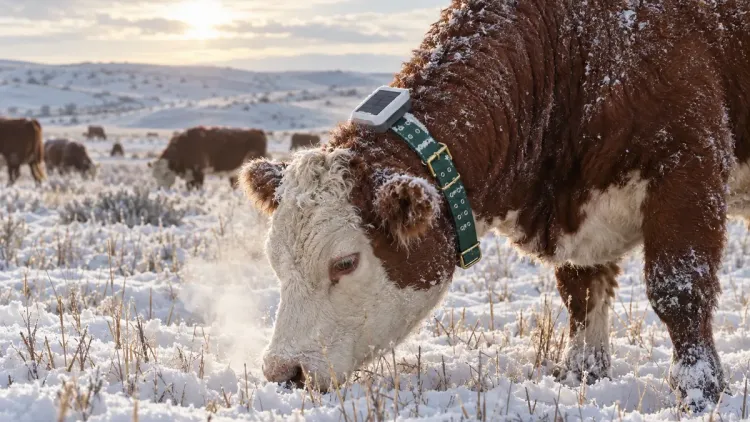
Modern livestock monitoring technology is transforming cattle feed cost management from a retrospective accounting exercise into a real-time optimization system. Smart eartag sensors that continuously monitor activity and body temperature give producers unprecedented visibility into how individual animals interact with their feed program — and where costs can be cut without sacrificing performance.
Digestive Health Monitoring
Healthy cattle ruminate 400-550 minutes per day. When rumination drops below normal thresholds — due to acidosis, ration changes, heat stress, or illness — it signals a digestive problem that directly impacts feed efficiency. Continuous activity and temperature monitoring through smart eartags flags the accompanying changes in an animal's behavior and body temperature within hours, alerting producers before the animal shows visible clinical signs. Herdwize eartags do not measure rumination itself today, but rumination monitoring is on the Herdwize roadmap. Early intervention on subclinical acidosis alone — adjusting ration formulation, buffering, or feeding management — can improve feed efficiency by 5-10% in affected animals. Across a pen or herd, activity and temperature trends allow producers to fine-tune rations based on actual animal response rather than theoretical nutritional models.
Early Disease Detection and Off-Feed Day Reduction
Every day an animal is off feed is a day of lost production and wasted overhead cost. Research on monitoring ROI shows that IoT-based early disease detection — identifying illness 24-48 hours before visual symptoms appear — reduces average treatment duration by 2-3 days and decreases the performance impact of illness events by 30-50%. In feedlot economics, reducing the average off-feed period from 7 days to 4 days per BRD case saves approximately $35-$60 per treated animal in feed efficiency loss alone. When you factor in reduced chronic cases, lower retreatment rates, and fewer animals that never recover full performance, the feed cost savings from early detection compound significantly across a feeding period.
Feed Behavior Pattern Analysis
Beyond individual animal monitoring, aggregated behavior data from sensor platforms reveals pen-level and herd-level patterns that inform management decisions. When a group of cattle shows declining activity around feeding times, it may indicate ration palatability problems, bunk management timing issues, heat stress, or social disruption from mixing groups. This pattern-level data replaces the traditional approach of waiting until performance drops appear in closeout data weeks or months later. Producers using feeding behavior analytics report adjusting ration formulations, feeding times, and bunk management protocols 2-4 weeks faster than those relying on traditional observation — a window that translates directly into recovered feed efficiency and lower cattle feed cost per pound of gain.
Feed Cost Calculator: Key Metrics
Building an effective cattle feed cost calculator requires tracking several interrelated metrics. These numbers allow producers to benchmark their operation, identify inefficiencies, and measure the impact of management changes or technology investments.
Cost per Pound of Gain
Cost per pound of gain is the most important economic metric in feedlot and backgrounding operations. It combines feed cost, feed conversion ratio, and daily gain into a single number that captures the economic efficiency of the feeding program. The formula is straightforward: daily feed cost divided by average daily gain. A steer with a daily feed cost of $4.50 gaining 3.5 pounds per day has a cost of gain of $1.29 per pound. At a selling price of $1.80 per pound live weight, that animal generates $0.51 per pound of margin. A steer in the same pen converting at only 2.8 pounds per day has a cost of gain of $1.61 — reducing per-pound margin by 63%. This is why individual variation in feed efficiency within a pen has such enormous economic consequences, and why monitoring tools that identify poor converters early are so valuable.
Feed Conversion Ratio (FCR)
Feed conversion ratio measures pounds of feed consumed per pound of gain. A typical feedlot FCR ranges from 5.5:1 to 7.5:1, meaning it takes 5.5 to 7.5 pounds of feed to produce one pound of live weight gain. Improving FCR by 0.5 points — from 6.5:1 to 6.0:1 — on a steer gaining 3.5 pounds per day reduces daily feed consumption by 1.75 pounds. At $0.17 per pound of TMR, that saves $0.30 per day, or $44.63 over a 150-day feeding period. Multiplied across 1,000 head, that single half-point FCR improvement saves $44,630 per turn. FCR is influenced by genetics, health status, ration formulation, environmental conditions, and digestive efficiency — making it the metric most responsive to the kind of management interventions that monitoring data enables.
Feed Cost per Hundredweight (CWT) of Production
For dairy operations, feed cost per hundredweight of milk produced is the primary efficiency benchmark. This metric directly links feed spending to revenue output. At a daily feed cost of $7.50 and daily production of 85 pounds of milk, the feed cost per CWT is $8.82. Industry benchmarks suggest that feed cost should represent 45-55% of the milk price — so at a $20 per CWT milk price, feed cost should ideally stay below $11.00 per CWT. Producers who track this metric daily through monitoring platforms can identify early dips in the feed-to-milk ratio and investigate whether the cause is ration quality, cow health, heat stress, or other factors before production loss accumulates.
Income Over Feed Cost (IOFC)
IOFC is the single best summary metric for dairy operations. It subtracts daily feed cost from daily milk revenue to show the margin available to cover all other expenses. An IOFC of $10-$14 per cow per day is generally considered healthy for a well-managed dairy. When IOFC drops below $8 per cow per day, it signals either a feed cost problem, a production problem, or both. Tracking IOFC in real time — rather than calculating it monthly from milk checks and feed invoices — allows producers to respond to margin erosion within days rather than weeks. This is particularly critical during periods of volatile milk or feed prices when the spread can shift rapidly.
Strategies to Optimize Feed Spending
Reducing cattle feed cost does not mean feeding less — it means feeding smarter. The following strategies have proven track records of lowering cost per unit of production while maintaining or improving animal performance.
1. Invest in Feed Storage and Handling Infrastructure
The cheapest feed you can buy is the feed you have already purchased but are currently losing to waste. Covering hay storage reduces losses from 25-35% to 2-5%. Properly packing and sealing silage bunkers can cut face losses from 15-20% to 3-5%. Maintaining feed mixing equipment to ensure consistent particle size and ration accuracy prevents both sorting and digestive upset. The return on storage infrastructure investment is typically 200-400% within the first two years, making it one of the highest-ROI capital expenditures available to cattle producers.
2. Optimize Bunk Management and Feeding Schedules
Delivering the right amount of feed at the right time reduces both waste and competition. Clean-bunk management — targeting bunks that are essentially empty at the next feeding — minimizes stale feed while ensuring adequate intake. Feeding at consistent times reduces cortisol and promotes regular intake patterns. In feedlots, twice-daily feeding with 60% of the ration delivered in the morning and 40% in the afternoon matches the natural intake rhythm of cattle and improves feed utilization. For operations with monitoring technology, real-time feeding behavior data enables precision bunk calls based on actual consumption patterns rather than estimates.
3. Source Alternative and Local Feed Ingredients
Many producers pay premium prices for conventional ingredients when lower-cost alternatives are available locally. Distillers grains, soybean hulls, corn gluten feed, bakery waste, and other co-products can replace a significant portion of conventional ration ingredients at lower cost per unit of energy or protein. The key is proper nutritional analysis and gradual ration transitions monitored through rumination data to confirm digestive adaptation. Producers located near ethanol plants, processing facilities, or food manufacturing can often secure contract pricing on co-product streams that reduces feed cost by 10-20% compared to commodity grain and hay alone.
4. Implement Strategic Purchasing and Forward Contracting
Feed ingredient markets follow predictable seasonal patterns overlaid with commodity cycle volatility. Corn prices typically dip at harvest in October-November. Hay prices are lowest at first cutting in June-July. Protein supplements follow soybean harvest timing. Producers who maintain 60-90 days of feed inventory and use forward contracts or basis contracts during seasonal lows can reduce annual feed cost by 5-12% compared to spot-market purchasing throughout the year. Building a relationship with a commodity broker or feed supplier who offers pricing tools is a low-cost step that many small and mid-size operations overlook.
5. Deploy Feed Efficiency Monitoring Technology
Continuous monitoring of activity, body temperature, and herd health through IoT sensor platforms like Herdwize provides the data foundation for every other optimization strategy. Without data, bunk management is guesswork. Without individual health monitoring, subclinical illness goes undetected. Without behavior trends, ration changes cannot be evaluated objectively. The investment in monitoring technology — typically $2-$5 per head per month — generates returns of $0.15-$0.40 per head per day in feed savings alone, before accounting for health, reproductive, and labor efficiency gains. For a 1,000-head beef operation, that translates to $54,000-$146,000 in annual feed cost reduction.
6. Regular Nutritional Testing and Ration Balancing
Feed ingredients are biological products with inherent variability. The protein content of a batch of distillers grains can vary by 3-5 percentage points. Hay quality changes with cutting, maturity, and storage conditions. Without regular testing, producers formulate rations based on book values that may not match actual nutrient content — leading to either expensive over-supplementation or performance-limiting deficiencies. Testing forages at every new lot and grains at least quarterly allows ration adjustments that optimize cost without sacrificing animal performance. The cost of a forage analysis ($15-$30 per sample) is trivial compared to the thousands of dollars wasted on improperly balanced rations.
Frequently Asked Questions
How much does it cost to feed a cow per day?
What is the average cattle feed cost per ton?
How can I reduce feed costs without hurting cattle performance?
What is a good feed conversion ratio for beef cattle?
How does feed efficiency monitoring technology pay for itself?
Ready to Reduce Feed Waste and Cut Costs?
See how Herdwize health and activity monitoring helps producers save $0.15-$0.40 per head per day on cattle feed cost.
Get a Feed Efficiency Assessment