Key Takeaways
- BRD costs the North American beef industry an estimated $900 million annually in treatment costs, mortality, and reduced performance (USDA APHIS)
- IoT sensors can detect BRD indicators 48-72 hours before visible clinical symptoms through temperature elevation and changes in activity
- Early treatment (within 24h of first signs) achieves 90%+ treatment success compared to 50-70% when treatment is delayed
- Late-treated BRD cases cost 2.3x more than early-treated cases due to extended treatment protocols and higher mortality
- Predictive monitoring reduces the need for metaphylactic antibiotic use, supporting responsible antimicrobial stewardship
Bovine Respiratory Disease (BRD) is the most economically devastating disease affecting North American beef cattle. Despite decades of research into vaccines, management practices, and treatment protocols, BRD remains the leading cause of morbidity and mortality in feedlot cattle and a significant drain on cow-calf operations.
The fundamental challenge with BRD isn't treatment — effective antibiotics exist. The challenge is timing. By the time a steer shows visible symptoms — nasal discharge, cough, depression, labored breathing — the disease has typically been progressing for 2-3 days. This delay between infection onset and clinical detection is the window where outcomes diverge: early intervention succeeds; late intervention often fails.
This article examines how continuous IoT monitoring closes that detection gap, the science behind predictive BRD alerts, and the practical impact for commercial beef operations.
The Economics of BRD
Before examining the technology, it's important to understand why BRD demands attention. The disease's economic impact extends far beyond treatment costs:
Treatment costs are just the visible portion. BRD survivors show reduced average daily gain (0.1-0.2 kg/day less), lower carcass quality, and reduced feed efficiency compared to animals that were never affected. A study by Schneider et al. (2009) found that cattle treated for BRD once had carcass values $40-$60 lower than untreated cohorts, while cattle treated multiple times showed reductions exceeding $100 per head.
For a 5,000-head feedlot with a 15% BRD morbidity rate, the total annual impact — treatment, performance loss, and mortality — can exceed $200,000-$400,000.
Why Visual Detection Fails
The current standard for BRD detection in most operations is the daily pen ride — trained riders moving through pens looking for cattle showing clinical signs. While experienced pen riders can achieve reasonable detection rates, this approach has inherent limitations:
The 48-72 Hour Blind Spot
BRD follows a predictable pathological progression. Initial viral infection damages the respiratory epithelium, creating conditions for secondary bacterial colonization. During this early phase, the animal's immune system is actively fighting the infection, resulting in measurable physiological changes — but not yet visible clinical symptoms.
Research by Pillen et al. (2016) demonstrated that core body temperature begins rising 48-72 hours before cattle display the clinical signs that pen riders look for. Rumination time decreases 24-48 hours before visible symptoms. Activity patterns change 12-36 hours before clinical detection.
This means that by the time a pen rider identifies a sick animal, the disease has already had 2-3 days to establish itself, damage tissue, and become more difficult and expensive to treat.
Once-Daily Observation Isn't Enough
Most operations check cattle once or twice daily. But disease progression doesn't pause between pen rides. An animal that appears normal at the morning check may be significantly ill by afternoon — and won't be identified until the next morning's ride, a full 24-hour delay on top of the existing blind spot.
Continuous monitoring eliminates this gap entirely. Temperature and activity data are collected around the clock, providing a resolution of detection that no pen riding schedule can match.
How IoT Sensors Detect BRD Early
Multi-sensor eartag devices detect BRD through a combination of physiological and behavioral signals that change during the subclinical phase of infection — before the animal shows visible symptoms.
Temperature Elevation
Fever is one of the earliest and most reliable indicators of BRD. The immune response to viral and bacterial infection drives core body temperature above the animal's individual baseline. Ear-mounted temperature sensors detect elevations as small as 0.5°C above baseline — well before the 40°C threshold used for clinical rectal temperature diagnosis.
The advantage of continuous monitoring is the ability to detect the trend rather than a single reading. A gradually rising temperature over 12-24 hours is a stronger indicator than any single measurement, because it distinguishes between disease-related fever and normal diurnal temperature variation.
Rumination Decline
Healthy cattle ruminate for 6-10 hours per day in a predictable pattern. One of the earliest behavioral responses to illness is a reduction in rumination time, as the animal diverts energy from digestion toward immune function. Research links a 30%+ decrease in rumination time to the 24-48 hours before clinical BRD symptoms appear.
This change is difficult to detect visually: a pen rider cannot tell an animal that ruminated for 8 hours yesterday from one that ruminated for only 5. Rumination itself is measured only by dedicated jaw-movement sensors, typically neck collars; temperature-and-activity ear tags do not measure it, but the reduced movement that accompanies it shows up in the activity signal described below. Herdwize ear tags work this way today, and rumination monitoring is on the Herdwize roadmap.
Activity Pattern Changes
Cattle developing BRD show measurable changes in activity patterns before clinical symptoms appear. These include reduced overall movement, fewer transitions between lying and standing, decreased social interaction, and changes in feeding behavior. Ear-tag pedometers capture these changes as a drop in step counts against the animal's own baseline. When combined with temperature data, activity changes add an independent confirmation signal that increases detection confidence and reduces false positives.
Multi-Signal Confirmation
The power of multi-sensor fusion for BRD detection lies in signal confirmation. A temperature spike alone might indicate exercise or ambient heat. An activity drop alone might indicate bad weather or a pen move. But when temperature rises and activity falls simultaneously in the same animal, the probability of disease is high — and the health risk score reflects this combined evidence.
Early Treatment: Why Timing Changes Everything
The clinical evidence is clear: earlier treatment leads to dramatically better outcomes.
| Treatment Timing | Success Rate | Avg. Cost/Case | Relapse Rate |
|---|---|---|---|
| Within 24h of first indicators | 90-95% | $23-$40 | 5-10% |
| At clinical symptoms (standard) | 70-80% | $50-$80 | 15-25% |
| 24h+ after clinical symptoms | 50-65% | $80-$151 | 30-40% |
Research by Theurer et al. (2015) demonstrated that first-treatment success rates decline significantly with each day of delayed treatment. Animals treated at the earliest signs of illness respond faster, require fewer retreatments, and show lower mortality rates than animals identified through traditional pen riding.
The economic difference is stark. For a feedlot with 100 BRD cases per year, moving from standard detection to early detection could save $5,000-$12,000 in direct treatment costs and prevent 3-5 deaths worth $4,500-$7,500 in mortality losses.
Reducing Metaphylactic Antibiotic Use
Metaphylaxis — the mass treatment of at-risk animals with antibiotics upon arrival at a feedlot — has been a common BRD prevention strategy. While effective at reducing initial BRD incidence, metaphylaxis raises legitimate concerns about antibiotic resistance, consumer perception, and cost.
Predictive monitoring offers an alternative approach: instead of treating all animals upon arrival, monitor all animals continuously and treat only those showing early indicators of disease. This targeted treatment approach can reduce total antibiotic use by 40-60% while maintaining — and often improving — health outcomes, because treatment is precisely targeted to animals that actually need it.
As regulatory and market pressure around antibiotic use in livestock continues to increase across both Canada and the United States, the ability to demonstrate targeted, data-driven treatment decisions becomes a competitive advantage for operations supplying premium and export markets.
Implementation for Beef Operations
Feedlot Deployment
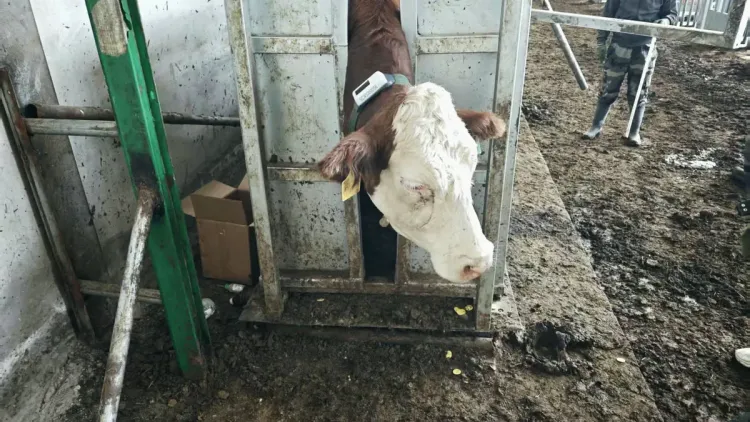
In feedlot environments, BRD monitoring focuses on the high-risk period — typically the first 45-60 days after arrival when morbidity peaks. Eartags are applied during processing, and the system establishes individual baselines during the first 7-14 days. After the baseline period, daily health risk scores are generated for every animal, with high-risk animals flagged for pull-and-check by pen riders.
Cow-Calf Operations
For cow-calf and ranch operations, BRD monitoring is particularly valuable during weaning stress and seasonal weather transitions — periods when calves are most susceptible. The private LoRa network, with each gateway covering a 5 km radius in open areas, enables monitoring across pastures and lots that cellular-dependent systems cannot reach.
Integration with Existing Protocols
Predictive monitoring complements rather than replaces existing veterinary protocols. Health risk scores help pen riders prioritize their daily checks — focusing attention on the 5-10 animals most likely to need treatment rather than scanning hundreds of head for subtle signs. Pull rates may actually decrease because animals are identified earlier when treatment is more effective, reducing retreatment and chronic cases.
Conclusion
BRD will remain a challenge in beef production for the foreseeable future. But the critical determinant of outcome — timing of detection and treatment — is now within our ability to change dramatically. Continuous IoT monitoring doesn't cure BRD, but it detects it during the window when treatment is most likely to succeed.
For operations currently relying on daily pen rides as their primary detection method, the 48-72 hour advantage provided by predictive monitoring translates directly into lower treatment costs, reduced mortality, fewer retreatments, and better-performing cattle. Combined with the reduction in metaphylactic antibiotic use, predictive BRD monitoring is one of the most impactful technology investments available to modern beef operations.
Want to Reduce BRD Losses in Your Operation?
See how Herdwize's predictive health monitoring detects BRD 48-72 hours before clinical symptoms.
Request a Platform Briefing