Key Takeaways
- Cattle begin showing measurable behavioral changes 48-72 hours before clinical symptoms become visible to human observers
- Late-detected illness costs 2.3x more to treat than illness caught early, with significantly higher mortality risk
- Bovine Respiratory Disease (BRD) alone costs the North American cattle industry over $900 million annually
- Continuous monitoring of body temperature and activity patterns enables predictive health alerts that shift veterinary care from reactive to proactive
- Early intervention reduces treatment duration by 40-60% and mortality rates by up to 50% in feedlot operations
In livestock production, the difference between early and late disease detection is not a matter of convenience — it is a matter of economics, animal welfare, and sometimes herd survival. Modern cattle health monitoring systems are changing this equation. A cow that receives treatment at the first signs of illness has a fundamentally different prognosis than one diagnosed 48 or 72 hours later. Yet on most commercial operations, disease detection still depends on human observation of clinical symptoms that are already well advanced by the time they become visible.
This article explores the science behind predictive cattle health alerts, the specific behavioral and physiological signals that precede clinical illness, and how IoT sensor platforms are transforming disease management from reactive to proactive.
The True Cost of Late Disease Detection
The economic impact of delayed disease detection operates on multiple levels, each compounding the others. Understanding these costs is essential for evaluating the value of predictive monitoring technology.
Direct Treatment Costs
Early-stage treatment for common cattle diseases such as BRD typically costs $15-$30 per animal, involving a single course of antibiotics and minimal veterinary intervention. When the same disease is detected at an advanced stage, treatment costs escalate to $50-$150 per animal, often requiring multiple drug protocols, extended treatment periods, supportive care, and veterinary oversight. The 2.3x cost multiplier is conservative — severe cases requiring intensive care can cost several hundred dollars per animal.
Production Losses
Sick cattle do not perform. Dairy cows with subclinical mastitis or respiratory illness show measurable milk yield reductions of 10-25% that can persist for weeks after clinical recovery. Feedlot cattle with BRD gain 0.10-0.20 kg/day less than healthy pen-mates during and after illness. These production losses are often larger than the direct treatment costs but are invisible in standard accounting because they manifest as reduced output rather than an explicit expense line.
Mortality and Chronic Loss
The most severe consequence of late detection is mortality. BRD mortality rates in feedlot cattle range from 1.5% to 5% of incoming animals, with the majority of deaths occurring in animals that were not identified and treated within the first 24-48 hours of illness onset. Beyond outright mortality, cattle that survive severe illness episodes often become chronic poor-doers with permanently reduced growth rates and reproductive performance, effectively becoming economic deadweight in the herd.
Bovine Respiratory Disease: The Industry's Billion-Dollar Problem
BRD deserves special attention because it is the single largest cause of death and economic loss in the North American cattle industry. The disease complex — caused by a combination of viral and bacterial pathogens interacting with stress, transport, commingling, and environmental factors — costs the industry an estimated $900 million to $1 billion annually in the United States and Canada combined.
What makes BRD particularly insidious is its progression. The initial viral phase often presents as a mild reduction in appetite and activity — changes that are virtually impossible to detect through once- or twice-daily visual observation in a pen of 200+ cattle. By the time the bacterial secondary infection produces obvious clinical signs (nasal discharge, labored breathing, depression), the disease has progressed significantly and lung damage may already be extensive.
This progression timeline creates a critical detection window: the 48-72 hours between the onset of measurable behavioral changes and the appearance of obvious clinical symptoms. Operations that can systematically identify animals in this early window have a fundamental advantage in treatment outcomes, costs, and mortality reduction.
The Behavioral Signals That Precede Clinical Illness
Decades of research in veterinary science and animal behavior have established that cattle exhibit measurable behavioral and physiological changes well before clinical symptoms become apparent. These changes are subtle, often imperceptible to human observers, but are consistently detectable by continuous sensor monitoring.
Temperature Elevation
Core body temperature is the earliest and most reliable indicator of the systemic inflammatory response that accompanies infection. In cattle, a sustained temperature elevation of 0.5-1.5°C above individual baseline typically precedes visible symptoms by 24-48 hours. Ear-based temperature sensors provide non-invasive continuous monitoring that captures these early elevations — including overnight temperature patterns that are missed by periodic rectal thermometer checks.
The critical nuance is that absolute temperature thresholds (such as "fever = above 39.5°C") are far less reliable than individual baseline deviations. A cow with a normal temperature of 38.2°C showing 39.0°C is in a very different situation than a cow with a normal of 39.0°C. Personalized baselines, established through continuous monitoring over the first 7-14 days, dramatically improve the sensitivity and specificity of temperature-based illness detection.
Activity and Rumination Changes
Sick cattle move less. This fundamental observation has been validated across hundreds of studies, but the quantitative pattern is more complex and informative than a simple reduction in step counts. During the pre-clinical phase, activity changes manifest as:
- Reduced feeding bout duration — cattle spend less time at the feed bunk, often by 15-30% before any visible reduction in intake is apparent
- Increased lying time — particularly during periods when healthy pen-mates are active
- Reduced rumination — the number of rumination minutes per day drops measurably, often by 20-40% during infection onset
- Altered head position patterns — sick cattle hold their heads lower on average and show reduced head movement variability
These behavioral shifts typically begin 12-36 hours before temperature elevation reaches detectable levels, providing an even earlier detection signal when combined with thermal monitoring.
Social Behavior Changes
Cattle are herd animals with consistent social patterns. Sick animals often separate from the group, spending more time at the periphery of the pen or pasture, and showing reduced interactions with pen-mates. Proximity sensors that track animal-to-animal interactions can detect these isolation patterns as an additional data channel for illness prediction.
How Predictive Health Monitoring Works
Modern livestock health monitoring platforms combine continuous data from multiple sensor channels with machine learning algorithms to generate predictive health alerts. The process works in several integrated stages.
Continuous Data Collection
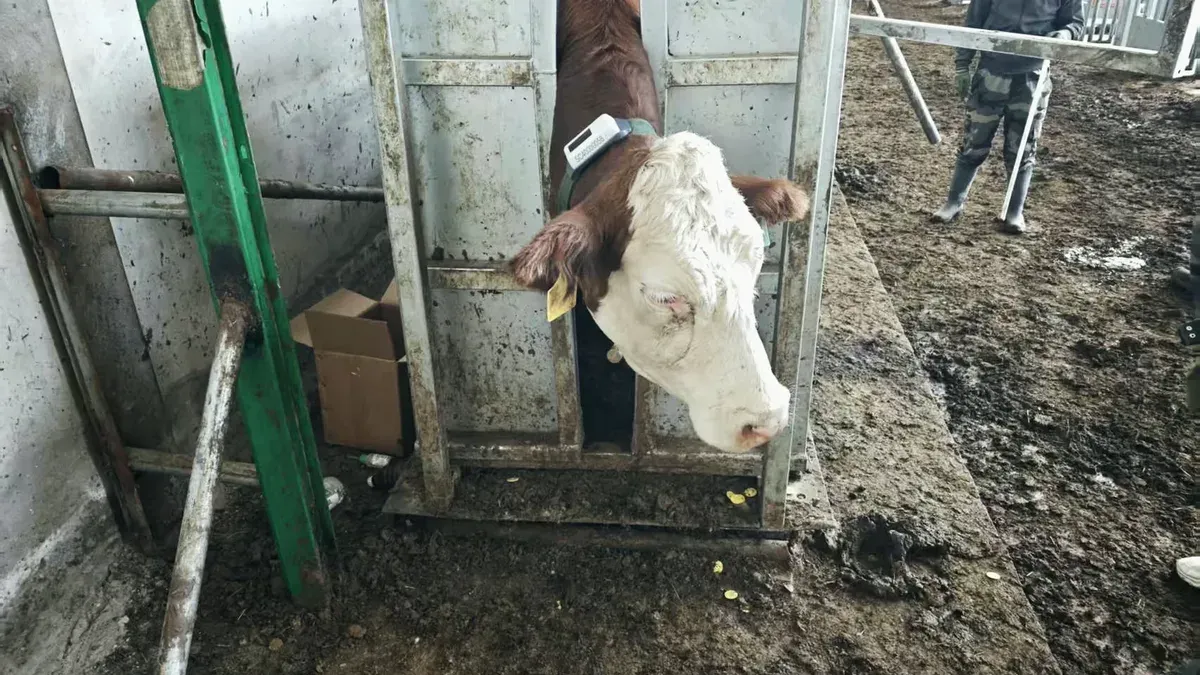
IoT-enabled eartags or collars collect activity data (step counts), body temperature readings, and — on GPS collars — location at regular intervals. This data is transmitted wirelessly to a gateway and then to the analytics platform, where it is processed and analyzed against each animal's established behavioral profile.
Individual Baseline Modeling
During an initial learning period, the system establishes a multi-dimensional behavioral profile for each animal. This baseline captures the normal ranges and daily patterns for activity levels and temperature fluctuations, plus grazing location for collared animals. Because cattle have highly individual behavioral signatures, these personalized baselines are far more predictive than population-level averages.
Anomaly Detection and Risk Scoring
The machine learning engine continuously compares incoming data against each animal's baseline, generating a health risk score that reflects the magnitude and consistency of deviations across multiple data channels. A single-channel deviation (such as a brief temperature blip) might generate a low-risk flag, while correlated deviations in temperature and activity at the same time generate a high-confidence health alert.
This multi-channel approach is critical for reducing false positives. Weather events, pen moves, feed changes, and estrus can all cause individual behavioral changes that mimic illness in a single channel. By requiring corroborating signals across independent data streams, the algorithm achieves high accuracy while maintaining a clinically useful false positive rate.
Actionable Alerts and Prioritization
The system delivers alerts to farm staff via mobile app or dashboard, prioritized by risk severity. High-confidence alerts trigger immediate notification, while lower-risk flags are compiled into daily review lists. This tiered approach ensures that the most critical cases receive immediate attention while avoiding alert fatigue from low-probability flags.
Real-World Impact: What the Data Shows
Field deployments of predictive health monitoring systems across commercial operations have demonstrated consistent improvements in detection timing and treatment outcomes:
| Metric | Without Monitoring | With Predictive Monitoring |
|---|---|---|
| Days to detection (from onset) | 3-5 days | 1-2 days |
| First-treatment success rate | 55-65% | 75-85% |
| Average treatment cost per case | $50-$80 | $20-$35 |
| BRD mortality rate (feedlot) | 2.5-5% | 1-2.5% |
| Chronic poor-doer rate | 8-12% | 3-5% |
The improvement in first-treatment success rate is particularly significant. When cattle are identified and treated during the early inflammatory phase rather than after clinical symptoms are well established, the probability that a single antibiotic course resolves the infection increases substantially. This reduces the need for second and third treatments, which add cost, increase antimicrobial usage, and carry their own risks of complications.
Beyond BRD: Other Conditions Detected by Continuous Monitoring
While BRD receives the most attention due to its economic scale, predictive health monitoring is equally valuable for detecting a range of other conditions:
- Mastitis in dairy cattle — activity and temperature changes precede somatic cell count spikes by 12-24 hours, enabling earlier intervention and reduced milk discard
- Metabolic disorders — ketosis and acidosis produce distinctive rumination pattern changes, detectable through jaw-movement analysis in rumination-sensing collars
- Lameness — gait changes reflected in altered activity patterns and lying behavior are identifiable before the condition becomes severe enough for visual detection
- Calving complications — deviations from normal pre-calving behavior patterns can alert staff to dystocia risk, enabling timely intervention
- Heat stress — temperature monitoring combined with activity data identifies animals struggling with thermal regulation before clinical heat stress occurs
Implementation Guide for Predictive Health Monitoring
Deploying a predictive health monitoring system is a strategic decision that requires planning across several dimensions:
- Start with high-risk groups — newly received cattle, fresh cows, and calving heifers offer the highest ROI for monitoring due to their elevated disease risk. Many operations begin with these groups before expanding to the full herd.
- Establish protocols before deployment — define how alerts will be triaged, who is responsible for checking flagged animals, and what treatment protocols are triggered by different alert levels. Technology without protocol changes delivers limited value.
- Allow the learning period — the first 7-14 days after tagging establish individual baselines. Be patient with alert accuracy during this period; the system improves rapidly as it accumulates individual behavioral data.
- Track and measure outcomes — record treatment timing, response rates, and costs before and after deployment. This data validates the ROI and identifies areas for protocol optimization.
Conclusion
The biological reality is that cattle telegraph their illness through behavioral changes long before those changes become visible to human observers. The technological reality is that continuous IoT monitoring can now detect those signals reliably and affordably at commercial scale. The economic reality is that early detection reduces treatment costs by half or more while dramatically improving outcomes.
For operations where disease management represents a significant cost center — which includes virtually every feedlot, dairy, and beef breeding operation — predictive health monitoring is not a futuristic concept. It is a practical, deployable technology with proven economics.
Detect Health Issues Before They Become Costly
Learn how Herdwize's predictive health alerts can reduce your treatment costs and mortality rates.
Request a Platform Briefing