Key Takeaways
- Cold stress costs the North American beef industry an estimated $500 million+ annually through increased mortality, weight loss, and excess feed consumption
- Cattle maintenance energy requirements increase by 1% for every degree Celsius below the lower critical temperature, meaning a -30C event can increase feed needs by 30% or more
- Continuous body temperature monitoring detects cold-stressed animals 6-12 hours before visible clinical signs such as shivering, lethargy, or frostbite
- Hypothermia is the #1 killer of newborn calves during winter calving, and dam temperature monitoring can predict calving onset even in extreme cold
- A private LoRa network keeps on-farm monitoring running with no cellular dependency, a major advantage for remote operations during Canadian and Northern US winters
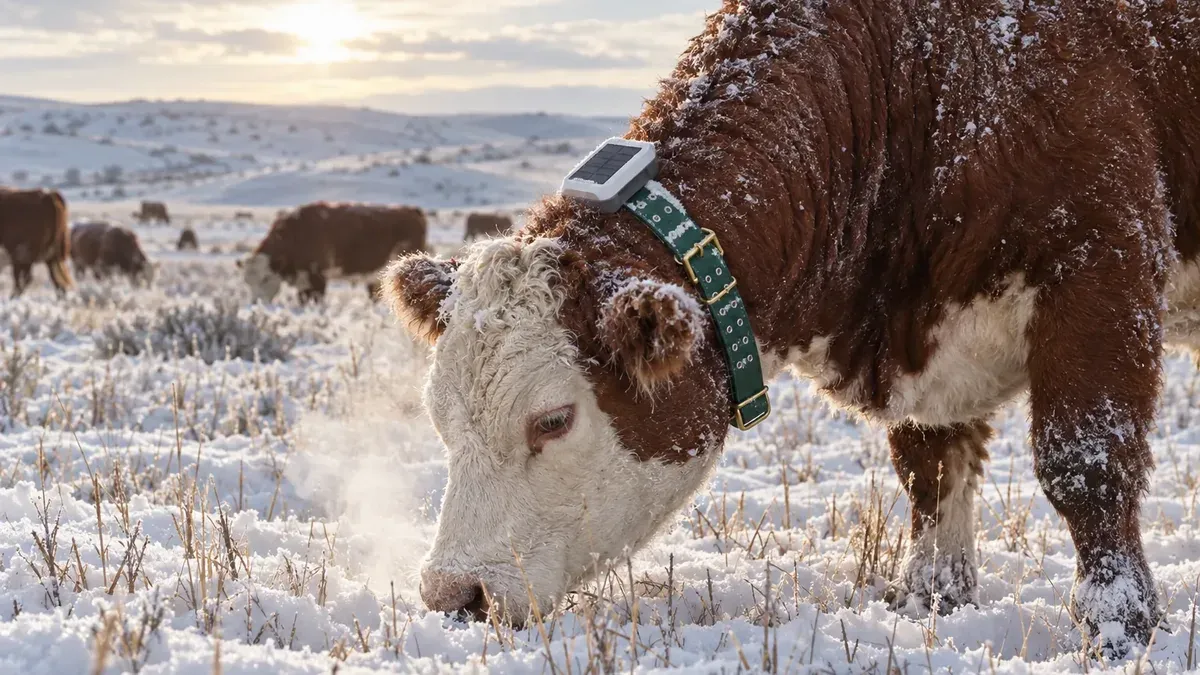
Winter on the Canadian prairies and Northern Great Plains is not a mild inconvenience for cattle producers. It is a four- to five-month operational reality where ambient temperatures routinely reach -30C to -40C, wind chills push effective temperatures below -50C, and the margin between a profitable year and a catastrophic one can hinge on how quickly a producer identifies and responds to cold stress events across a dispersed herd.
For generations, winter cattle management has relied on the same approach: increase feed, provide windbreaks, check cattle as often as physically possible, and accept a certain level of winter loss as inevitable. IoT-based monitoring technology is changing that calculus by providing continuous, real-time visibility into individual animal condition during the months when visual observation is hardest and the stakes are highest.
The Scale of Winter Losses
Cold stress in cattle is not a niche problem. It is a systemic economic drain on beef and dairy operations across Canada and the Northern United States, where approximately 40 million beef cattle spend at least four months of every year in conditions that can exceed their thermoregulatory capacity.
The economic impact of cold stress operates across multiple categories. Weight loss during prolonged cold events can reach 0.5-1.5 kg per day as cattle divert metabolic energy from growth to thermoregulation. Feed costs spike as maintenance energy requirements increase dramatically. Frostbite damages ears, tails, teats, and scrotums, reducing future productivity and breeding value. And in the most severe cases, hypothermia kills outright, particularly among calves, thin cattle, and animals compromised by illness.
The 2023-2024 winter season in Alberta and Saskatchewan was a stark reminder: multi-day cold snaps with sustained temperatures below -35C caused reported cattle losses across dozens of operations, with calving-season losses especially severe in operations that could not identify and respond to distressed animals quickly enough.
Understanding Cold Stress Physiology
Effective cold stress monitoring requires understanding the physiological mechanisms at play. Cattle are homeotherms that maintain a core body temperature of approximately 38.5C regardless of ambient conditions. When environmental temperature drops below an animal's lower critical temperature (LCT), the animal must increase its metabolic rate to maintain body heat, consuming additional energy that would otherwise be directed toward growth, milk production, or fetal development.
Lower Critical Temperature Varies by Animal
The LCT is not a fixed number. It varies significantly based on breed, body condition score, hair coat condition, acclimatization status, and whether the coat is wet or dry. A well-conditioned, dry-coated Angus cow may have an LCT of -20C, while a thin Hereford heifer with a wet coat may begin experiencing cold stress at 0C. This variability is precisely why population-level weather alerts are inadequate for managing cold stress. What matters is whether each individual animal is coping, and that requires individual-level monitoring.
The Energy Cost of Cold
For every degree Celsius below an animal's LCT, maintenance energy requirements increase by approximately 1%. During a -35C event, a cow with an LCT of -15C faces a 20-degree deficit, translating to a 20% increase in maintenance energy needs. If the cold persists with wind chill pushing effective temperature to -45C, the deficit expands to 30 degrees and a 30% energy increase. This is not optional energy. If it is not supplied through additional feed, the animal will catabolize body reserves, lose weight, become immunocompromised, and enter a downward spiral that can end in death.
Measurable Body Temperature Changes
When a cow's thermoregulatory capacity is overwhelmed, core body temperature begins to drop. A sustained drop of 0.5-1.0C below individual baseline indicates significant cold stress. A drop of 1.5C or more signals hypothermic risk. These changes are measurable by continuous temperature sensors well before clinical signs such as shivering, lethargy, or recumbency become apparent to human observers, providing a critical early intervention window.
How IoT Sensors Detect Cold Stress
IoT-enabled eartags and collars provide multiple independent data channels that, when analyzed together, create a comprehensive picture of each animal's cold stress status. Unlike periodic visual checks that occur once or twice daily, sensor data flows continuously, capturing the gradual physiological changes that precede clinical cold stress.
Continuous Body Temperature Monitoring
Ear-based temperature sensors measure body temperature at regular intervals, establishing individual baselines and detecting deviations as they develop. During cold stress events, the analytics platform identifies animals whose body temperature is declining relative to their established baseline, flagging them for intervention before hypothermia develops. This is particularly valuable at night, when temperatures are lowest and visual observation is impossible.
Activity Pattern Changes
Cold-stressed cattle exhibit distinctive behavioral changes that show up in step-count activity monitoring:
- Huddling behavior — cattle cluster together to reduce wind exposure and share body heat, reducing individual movement patterns
- Reduced feeding activity — animals may reduce trips to feed bunks in extreme cold, particularly if bunks are exposed to wind
- Decreased water intake — cattle reduce water consumption in extreme cold, partly due to frozen water sources and partly due to the metabolic cost of warming ingested water
- Longer inactive periods — cattle may lie down to reduce their surface area exposed to wind, but prolonged lying in snow or on frozen ground accelerates heat loss
Daily Activity Rhythm
Disruption of an animal's normal daily activity rhythm is a particularly useful indicator of cold stress. During extreme cold events, cattle change how much and when they move even when adequate feed is available, as they redirect metabolic energy toward thermoregulation. Because the platform compares each animal's step counts against its own baseline for the same time of day, these shifts stand out clearly. A herd-wide activity decline during a cold event is a strong signal that current management interventions (windbreaks, bedding, feeding levels) are insufficient.
GPS Location Data
GPS-enabled collars add spatial intelligence to cold stress monitoring. Location data reveals whether cattle are using available windbreaks or remaining in exposed areas, which animals are failing to travel to feed and water sources, and whether the herd is distributing normally across the pasture or clustering in ways that suggest environmental stress. An animal that stops traveling to the feed bunk during a -35C event is in immediate danger that would not be apparent until the next visual check.
Automated Cold Stress Alerts
Raw sensor data becomes actionable through the alert engine that processes individual and population-level signals to generate prioritized notifications.
Individual Animal Alerts
Threshold-based alerts trigger when an individual animal's body temperature drops below a defined deviation from baseline, when activity levels fall below expected ranges for the time of day, or when total daily step counts decline beyond normal variation. These alerts identify the specific animals that are struggling, enabling targeted intervention rather than whole-herd response.
Population-Level Monitoring
When 30% or more of a herd simultaneously shows temperature depression or activity decline, the system classifies the event as environmental rather than individual. This distinction is critical for management decision-making. An individual alert means "check this animal." A population alert means "your current cold management strategy is failing — increase feed, add bedding, open windbreak access, or move cattle to shelter." This population-level signal prevents producers from treating symptoms (individual cold-stressed animals) while missing the cause (inadequate environmental management).
Weather Integration
Integration with Environment Canada and NOAA weather forecast data enables proactive alerts before cold events arrive. When a polar vortex event is forecast to bring temperatures below -30C, the system can alert producers 24-48 hours in advance to pre-position additional feed, ensure water systems are functioning, check bedding depth, and prepare calving facilities. This proactive posture is the difference between managing cold stress and reacting to it.
Winter Feeding Optimization
Feed is the single largest operating cost on most beef cattle operations, and winter feeding decisions are among the most consequential. Underfeed during cold stress and cattle lose condition, get sick, or die. Overfeed and margins evaporate. The challenge is that the "right" amount of feed changes daily based on temperature, wind, precipitation, and the condition of each animal.
Quantifying the Cold Tax
The 1%-per-degree rule provides a baseline for cold-weather feeding adjustments, but actual requirements vary by animal. Continuous monitoring data allows producers to validate whether their feeding adjustments are adequate by tracking individual activity and body temperature patterns after ration increases.
| Ambient Temperature | Wind Chill Effective Temp | Est. Feed Increase Needed | Monitoring Indicator |
|---|---|---|---|
| -15C to -20C | -25C to -30C | 10-15% | Slight activity decline in thin cattle |
| -20C to -30C | -30C to -40C | 15-25% | Herd-wide activity decline, reduced feeding trips |
| -30C to -40C | -40C to -55C | 25-40% | Body temp depression, huddling, feeding cessation |
| Below -40C | Below -55C | 40%+ | Emergency: population-level temp drops, minimal activity |
Feeding Behavior Validation
A common winter management failure is increasing the ration without verifying that cattle are actually consuming it. Frozen feed bunks, iced-over silage faces, and snow-covered bale grazing sites can prevent cattle from accessing additional feed even when it has been provided. Activity and GPS data reveal whether animals are traveling to feeding sites and spending adequate time there. A producer who increases rations by 25% but sees no corresponding increase in feeding-site activity knows there is an access problem, not just a volume problem.
Calf Monitoring During Winter Calving
Winter calving is the highest-risk period on any ranch operation. A calf born at -30C has approximately 30-60 minutes before hypothermia becomes life-threatening if it does not stand, nurse, and receive adequate colostrum. The difference between a live calf and a dead one is often the speed of human response, which depends entirely on knowing that a calving event has occurred.
Pre-Calving Detection
Cows exhibit predictable behavioral changes in the 12-24 hours before calving: increased restlessness, separation from the herd, altered lying patterns, and a measurable 0.3-0.5C body temperature drop approximately 8-12 hours before parturition. Smart eartag sensors track the temperature drop and rising restlessness, and GPS collars show separation from the herd, alerting producers that a calving event is imminent and enabling them to move the cow to a sheltered calving area or prepare for a field response.
Calving Location Identification
GPS tracking identifies the precise location where a cow has calved, which is essential for rapid response in large pastures. In winter conditions with limited visibility, deep snow, and short daylight hours, knowing the exact GPS coordinates of a calving event can reduce response time from hours to minutes. For operations calving on pasture, this is often the difference between saving and losing the calf.
Newborn Vigor Assessment
After birth, the dam's behavior patterns indicate whether the calf is vigorous and nursing or struggling. A cow whose activity settles and who remains largely stationary (indicating nursing activity) within 2-3 hours post-calving signals a healthy outcome. A cow that shows persistent restlessness, excessive movement, or failure to settle suggests a calf that has not successfully nursed, triggering a welfare alert for producer intervention.
Water Access Monitoring
Frozen waterers are a silent killer in winter cattle operations. A mature beef cow requires 30-50 liters of water daily even in cold weather, and dehydration in winter is more common and more dangerous than most producers realize. The challenge is that frozen water systems can fail overnight, and cattle may not show obvious signs of dehydration for 24-48 hours, by which time significant physiological damage has already occurred.
Detecting Water System Failures
A sudden, herd-wide change in activity patterns is a strong indicator of water access failure. GPS data that shows animals clustered at a water source but not exhibiting normal drinking behavior patterns (brief visits, then movement away) suggests the source has frozen. These signals enable producers to identify and repair frozen waterers within hours rather than discovering the problem during the next scheduled check, potentially 12-24 hours later.
Infrastructure Benefits of a Private LoRa Network in Winter
Any monitoring system is only as reliable as its connectivity infrastructure, and winter is when reliability matters most. Private LoRa technology offers specific advantages for winter livestock monitoring that cellular and satellite alternatives cannot match.
Planning for Extreme Cold
The Herdwize LoRa gateway is housed in an IP66 waterproof shell and rated for operation from -20C to 70C, so on prairie sites where winter lows regularly fall below -20C, its installation location needs to be planned with that range in mind. Cellular towers, by contrast, can experience equipment failures during prolonged extreme cold events, precisely when monitoring is most critical. In January 2024, multiple cellular carriers reported service degradation across Alberta and Saskatchewan during a week-long cold snap, leaving cellular-dependent monitoring systems blind during the period of highest risk.
No Cellular Dependency
Private LoRa gateway networks operate independently of telecom infrastructure. A farm-owned gateway receiving data directly from the collars and sensors within its 5 km open-area radius has zero dependency on cellular coverage, which is especially important in the remote locations where winter cattle operations typically run. When a blizzard takes down cellular service for three days, a gateway on a wired internet connection keeps monitoring running.
Wired Backhaul
The Herdwize gateway reaches the cloud platform over a wired Ethernet connection rather than a cellular modem, so the path from the farm to the analytics platform runs over the same internet service as the farm office instead of the nearest cell tower. Protecting that connection, and the router it plugs into, is the key step in keeping winter monitoring online.
Low Power for Outage Resilience
Winter storms frequently cause power outages in rural areas that can last days. The Herdwize gateway draws less than 4 W from a 12 V DC adapter, so it is simple to keep running on a standby power source, along with the farm's internet equipment, through extended outages, maintaining monitoring coverage when animals are most vulnerable. This resilience is not a theoretical benefit. It is a practical necessity in regions where winter power reliability is measured in "outages per season" rather than "uptime percentage."
Economic Impact of Winter Monitoring
The financial case for IoT-based winter monitoring is built on losses that are already occurring and can be quantified. For a 1,000-head cow-calf operation in Alberta or Saskatchewan, the winter-specific economic value of continuous monitoring includes:
Winter Monitoring ROI -- 1,000-Head Cow-Calf Operation
The mortality reduction alone often justifies the monitoring investment. Losing even 10 mature cows during a winter storm represents $15,000-$20,000 in direct replacement value, plus the genetic investment, lost calf revenue, and the intangible cost of finding dead animals in the spring. For operations that also calve during winter months, the calf survival improvement adds substantially to the return. A 1,000-head operation calving 900 calves with a 5% winter calf loss rate is losing 45 calves per year. Reducing that to 3% saves 18 calves at $1,200 each, generating $21,600 in recovered revenue from a single management improvement.
Feed Optimization Savings
The feed optimization value is often overlooked but is significant. Without individual animal data, producers must make blanket feeding decisions based on weather forecasts and general guidelines. This typically results in overfeeding on mild days (waste) and underfeeding during severe events (loss). Continuous monitoring data allows producers to calibrate feeding to actual animal condition, reducing feed waste by an estimated 8-12% during the winter feeding period without compromising animal welfare or performance.
Labor Reduction
Winter cattle checks are physically demanding, time-consuming, and often dangerous work performed in conditions that no other industry would consider acceptable. Night checks during calving season mean driving or riding through dark pastures at -30C, looking for animals in distress. Continuous monitoring does not eliminate the need for physical checks, but it can reduce their frequency by providing real-time assurance that animals are maintaining normal temperature and activity patterns. When an alert does fire, the producer knows exactly where to go and which animal needs attention, converting a general patrol into a targeted response.
Conclusion
Winter cattle management in Canada and the Northern United States has always been a test of preparation, endurance, and judgment. IoT monitoring technology does not replace the producer's knowledge or commitment. What it provides is continuous visibility into the condition of every animal in the herd during the months when visibility is hardest to achieve, when the consequences of missed problems are most severe, and when the economic impact of losses is most concentrated.
The combination of continuous temperature monitoring, activity tracking, GPS location data, and population-level analytics creates a winter management system that identifies cold stress before it becomes hypothermia, validates feeding strategies as conditions change, detects water system failures within hours, and provides early warning of calving events in extreme conditions. Built on a private LoRa network with no cellular dependency on the farm, this capability is available precisely when and where it is needed most.
For producers who have accepted winter losses as an unavoidable cost of northern cattle production, the question is straightforward: how much of that loss is actually preventable with better information, delivered faster?
Protect Your Herd This Winter
Learn how Herdwize's cold stress monitoring and automated alerts can reduce your winter losses and optimize feeding decisions.
Request a Winter Management Briefing