Key Takeaways
- Spreadsheet-based herd records become unreliable past 200 head — data entry errors increase 3-4x compared to purpose-built software, and real-time alerting is impossible
- Every cattle management platform should cover four core modules: animal records, health tracking, breeding/calving management, and analytics/reporting
- Record-keeping software and real-time monitoring platforms solve fundamentally different problems — historical data vs. predictive intelligence — and understanding the distinction prevents costly purchasing mistakes
- Sensor-integrated platforms that ingest IoT data automatically reduce manual data entry by 60-80% while enabling alerts that static record-keeping software cannot provide
- Implementation success depends on three factors: herd size thresholds, connectivity infrastructure, and staff adoption — not just software features
Cattle management software has evolved from simple digital ledgers into comprehensive operational platforms that track every dimension of herd performance. Yet the market is fragmented — dozens of apps, cloud platforms, and sensor-integrated systems compete for producer attention, each making similar claims about "complete herd management." For producers evaluating their options, the challenge is not finding software; it is determining which architecture, feature set, and data model actually fits their operation.
This guide provides a structured framework for evaluating cattle management software. We examine what features are essential, how record-keeping differs from real-time monitoring, what sensor integration changes about the data pipeline, and how to match platform architecture to your herd size, management style, and technology readiness.
Why Spreadsheets and Paper Records Fall Short at Scale
Most cattle operations start with paper records or spreadsheets, and for small herds under 50 head, these tools work acceptably well. A producer managing 30 cows can keep breeding dates in a notebook, track treatments on a whiteboard, and rely on memory for individual animal histories. The problem is that these methods do not scale — and they fail in ways that are difficult to detect until the damage is already done.
The Data Entry Burden
Manual data entry is the single largest bottleneck in spreadsheet-based herd management. A study by the University of Guelph found that producers manually entering cattle data into spreadsheets averaged 12-18 minutes per animal per year for basic records — weight, treatments, breeding events, and calving outcomes. For a 500-head operation, that translates to 100-150 hours of annual data entry, nearly four full working weeks dedicated exclusively to typing numbers into cells. The error rate compounds the problem: manual transcription introduces a 2-5% data entry error rate, meaning that at any given time, 10-25 animal records in a 500-head spreadsheet contain incorrect information.
No Real-Time Alerts
Spreadsheets are inherently static. They store what has already happened but cannot alert you to what is happening right now. A cow showing early signs of bovine respiratory disease at 2 AM will not trigger a notification from a Google Sheet. A heifer entering estrus on a Sunday morning will not send a text message from an Excel file. This reactive gap — the time between an event occurring and a human noticing it — is where the majority of preventable losses in cattle operations originate. Research from Colorado State University estimates that delayed detection of health events costs the average feedlot $15-$25 per head annually in excess treatment costs and lost performance.
No Trend Analysis
Even when spreadsheet data is accurate, extracting meaningful trends requires significant analytical skill. Identifying that conception rates have declined 8% over the past three breeding seasons, or that first-lactation heifers from a specific sire line have 2.3x higher BRD incidence, requires cross-referencing multiple tabs, building pivot tables, and knowing which questions to ask. Purpose-built cattle management software automates these analyses, surfacing patterns that would take hours to discover manually — or that a producer might never think to look for.
Core Features Every Cattle Management Platform Needs
Regardless of whether you choose a mobile app, a cloud platform, or a sensor-integrated system, four functional modules form the foundation of any credible cattle management software. A platform missing any of these forces you to maintain parallel systems, which defeats the purpose of digitizing herd records.
1. Animal Records and Identification
The animal record is the atomic unit of cattle management software. Every animal in the system needs a unique identifier linked to its complete history: birth date, sire and dam, breed composition, purchase date, current location, group assignment, and status (active, sold, culled, died). The best platforms support multiple ID types per animal — visual tag number, electronic ID (EID), RFID, and registration number — with cross-referencing so that any ID can retrieve the full record. Look for systems that support bulk import from existing spreadsheets, because migrating 500+ animal records manually is a non-starter.
2. Health Tracking and Treatment Records
Health tracking must go beyond simple treatment logs. Effective cattle management software records the full treatment chain: initial observation or alert, diagnosis, treatment protocol (drug, dosage, route, withdrawal period), response assessment, and outcome. Withdrawal period tracking is non-negotiable for any operation selling animals or milk — the software should automatically flag animals approaching or within withdrawal periods and prevent them from being added to sale or shipment lists. Look for platforms that maintain a drug inventory, track usage against purchase records, and generate the treatment summaries required for veterinary audits and quality assurance programs like the Canadian Verified Beef Production Plus (VBP+) program.
3. Breeding and Calving Management
Breeding management is where cattle management software delivers its most measurable ROI. The platform should track breeding events (natural service or AI), sire assignments, pregnancy check results, expected calving dates, and calving outcomes including dystocia scoring. Calving records should capture calf birth weight, vigor score, colostrum intake, and any complications. Advanced platforms calculate key reproductive KPIs automatically: conception rate, services per conception, calving interval, calving distribution, and 21-day pregnancy rate. These metrics, updated in real time as events are recorded, replace the end-of-season guesswork that characterizes manual record-keeping.
4. Reporting and Analytics
Raw data without analysis is just noise. The reporting module should provide both operational reports (animals due for treatment, upcoming calvings, pregnancy check lists) and strategic analytics (herd performance trends, sire comparison reports, economic summaries). Export capabilities matter: the ability to generate CSV, PDF, and API-accessible reports ensures compatibility with external systems like accounting software, genetic evaluation programs, and buyer portals. The best platforms offer customizable dashboards that surface the 5-10 metrics most relevant to each user's role — the herd manager sees different data than the nutritionist or veterinarian.
Record-Keeping vs Real-Time Monitoring: Understanding the Difference
The most common mistake producers make when evaluating cattle management software is conflating record-keeping with monitoring. These are fundamentally different capabilities, and understanding the distinction is essential for choosing the right platform.
Record-keeping software digitizes what a producer manually observes and enters. It is a database with a user-friendly interface — structured, searchable, and reportable, but ultimately dependent on a human typing in data after an event occurs. Real-time monitoring platforms, by contrast, continuously ingest data from sensors, cameras, or automated systems and generate alerts based on algorithmic analysis of that data stream. The difference is not just speed; it is a fundamental shift from reactive documentation to predictive intelligence.
| Dimension | Record-Keeping Software | Real-Time Monitoring Platform |
|---|---|---|
| Data source | Manual human entry | Automated sensor ingestion + manual entry |
| Data latency | Hours to days (entered after observation) | Minutes (continuous sensor transmissions) |
| Alerting | Calendar reminders (vaccination due dates) | Predictive alerts (health, estrus, calving onset) |
| Night/weekend coverage | None — requires human presence | 24/7 automated monitoring and notification |
| Behavioral baselines | Not possible — no continuous data | Individual baselines for activity, temperature (and rumination where measured) |
| Typical cost | $0-$500/year (subscription or one-time) | $2,000-$15,000/year (hardware + platform) |
| Best for | Compliance, historical records, basic reporting | Health prediction, estrus detection, calving alerts |
Neither approach is inherently superior — they serve different purposes. Small operations with hands-on management may extract excellent value from record-keeping software alone. Larger operations, or those where labor constraints limit visual observation frequency, need the predictive capabilities that only real-time monitoring provides. The Herdwize platform integrates both capabilities: automated sensor data ingestion for real-time monitoring, combined with a full record-keeping layer for treatments, breeding events, and compliance documentation.
What Sensor Integration Changes
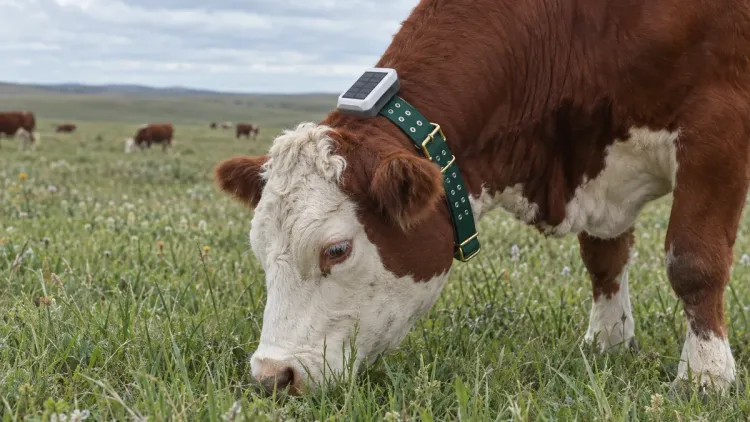
When cattle management software connects directly to IoT sensors, the data pipeline changes fundamentally. Instead of a producer walking pens, observing animals, and manually entering observations into an app, sensors continuously stream physiological and behavioral data into the platform — body temperature and activity from ear tags, and GPS positions from collars every 1-30 minutes depending on the model. This automated data flow has three transformative effects on herd management.
Eliminating the Observation Gap
A typical producer visually observes each animal for 30-90 seconds during daily checks. That means 99.9% of each animal's day goes unobserved. Sensor-integrated platforms close this gap entirely. A smart ear tag reporting activity and temperature around the clock builds a continuous record for every animal, every day — compared to 1-2 visual observations. This density of data is what enables predictive algorithms to detect the subtle behavioral shifts that precede illness, estrus, and calving by 24-72 hours.
From Manual Entry to Automated Ingestion
Sensor integration eliminates the majority of manual data entry. Activity levels, temperature trends, and GPS location data flow into the platform automatically. The producer's role shifts from data entry operator to decision maker — reviewing alerts, confirming diagnoses, and recording treatment actions. Operations that deploy sensor-integrated platforms report 60-80% reduction in time spent on data entry, freeing staff for higher-value management tasks.
Enabling Predictive Analytics
Record-keeping software can tell you what happened. Sensor-integrated platforms can tell you what is about to happen. By analyzing continuous data streams against individual animal baselines and herd-level patterns, the platform's machine learning algorithms generate predictive alerts: this cow is likely in estrus (based on 4.2x increase in nighttime activity), this steer is developing a respiratory infection (based on 1.8-degree temperature elevation and 22% activity decline), this heifer is within 12 hours of calving (based on temperature drop and restlessness pattern). These predictions are impossible without continuous sensor data — no amount of manual observation or record-keeping can replicate them.
Evaluating Cattle Management Software: Decision Matrix
The following matrix compares three platform architectures across the dimensions that matter most for commercial cattle operations. Use this as a starting framework, then weight each dimension according to your operation's specific priorities.
| Evaluation Criteria | Standalone Mobile App | Cloud Platform | Sensor-Integrated Platform |
|---|---|---|---|
| Animal records | Basic ID, notes, photos | Full records with multi-user access | Full records + automated sensor data |
| Health monitoring | Manual treatment logs | Treatment logs + withdrawal tracking | Predictive health alerts + treatment logs |
| Estrus detection | Manual observation entry | Calendar-based predictions | Automated detection (90%+ accuracy) |
| Calving management | Due date calculator | Due dates + calving record forms | Predictive calving alerts (12-hr window) |
| Reporting | Basic summaries, limited export | Custom reports, CSV/PDF export, dashboards | Real-time dashboards, trend analytics, API access |
| Multi-user access | Single device, no role management | Multi-user with role-based permissions | Multi-user + veterinarian/advisor portals |
| Offline capability | Full offline (local storage) | Limited (sync when connected) | Private farm network; cloud sync when connected |
| Upfront cost | $0-$200 (one-time or freemium) | $200-$1,500/year | $5,000-$25,000 (hardware + subscription) |
| ROI timeline | Immediate (low cost) | 3-6 months | 6-18 months (larger savings at scale) |
| Best fit | <100 head, single operator | 100-500 head, multi-site | 300+ head, labor-constrained, high-value stock |
Implementation Considerations
Choosing the right cattle management software is only half the challenge. Successful implementation requires realistic assessment of three factors that determine whether the technology delivers value or becomes an expensive shelf decoration.
Herd Size Thresholds
Software platform complexity should scale with herd size. Operations under 100 head can typically manage effectively with a well-designed mobile app and disciplined record-keeping habits. Between 100 and 300 head, the coordination challenges of multi-user access, breeding program management, and regulatory compliance make a cloud platform the practical minimum. Above 300 head — particularly in operations running multiple sites or managing both cow-calf and feedlot segments — sensor-integrated platforms deliver the strongest ROI because the labor savings from automated monitoring compound with herd size. A 1,000-head operation using sensors saves 400-600 hours of annual observation and data entry labor compared to manual systems, equivalent to $8,000-$15,000 in labor cost alone.
Connectivity Infrastructure
Cloud platforms and sensor-integrated systems require reliable data connectivity — and rural cattle operations are precisely the environments where connectivity is weakest. Before committing to any platform that depends on internet access, assess your connectivity reality: What is your typical download/upload speed? How often does the connection drop? Are there areas of the property with no coverage at all?
Sensor-integrated platforms built on a private LoRa network have a significant advantage in rural environments. LoRa operates on license-free spectrum, and the Herdwize LoRa gateway covers a 5 km radius in open areas without depending on cellular coverage anywhere on the property. The gateway itself needs a wired Ethernet internet connection to sync data to the cloud, but only where the gateway is installed, not across every pasture. This architecture means that a sensor-integrated platform can collect data reliably across pastures where a cellular-dependent system would leave gaps.
Staff Training and Adoption
The most feature-rich cattle management software is worthless if your team does not use it. Staff adoption is the single most common failure point in agricultural technology deployments. Successful implementation requires three elements: a designated champion (one person accountable for driving adoption), structured training during a low-intensity period (not during calving season or fall processing), and a clear answer to the question every employee will ask — "how does this make my job easier?"
Start with the highest-value, lowest-friction use case. For most operations, this means deploying health alerts first: staff see immediate value when the system sends a notification about a sick animal they had not yet identified visually. Once trust in the system is established through health alerts, expanding to breeding management, calving prediction, and full record-keeping encounters far less resistance. Phased rollouts consistently outperform big-bang deployments in agricultural technology adoption.
Frequently Asked Questions
Can cattle management software replace my veterinarian?
How long does it take to migrate existing herd records into a new platform?
Do I need internet connectivity for cattle management software to work?
What herd size justifies investing in a sensor-integrated platform?
Ready to Move Beyond Spreadsheets?
Our team can walk you through how the Herdwize platform combines record-keeping, real-time monitoring, and predictive analytics — tailored to your herd size and operation type.
Request a Platform Demo