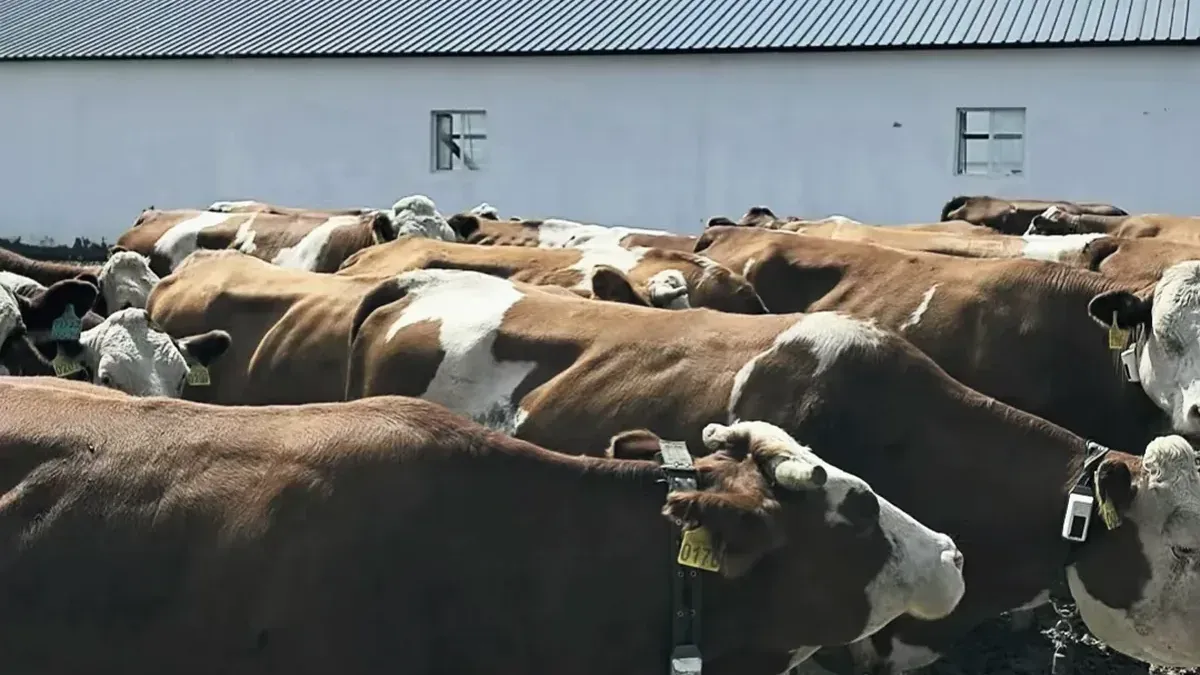
Key Takeaways
- Beef cattle monitoring priorities differ fundamentally from dairy — BRD detection, calving alerts, and weight gain tracking replace milk yield and parlor-based metrics
- Feedlot BRD costs the North American beef industry $900 million annually, with predictive monitoring reducing treatment costs by 40-60% through 48-72 hour early detection
- Cow-calf operations using calving alert technology report 35-50% reduction in calf mortality and 2-4 fewer hours of nightly surveillance labor during calving season
- A private LoRa network covers a 5 km radius per gateway in open areas, solving the infrastructure challenge that makes cellular-based systems impractical for extensive beef operations
- A 1,000-head feedlot implementing predictive health monitoring can recover $45,000-$75,000 annually in reduced death loss, lower treatment costs, and labor savings
Beef cattle monitoring is a fundamentally different discipline from dairy monitoring. Where dairy operations run intensive, facility-based systems built around twice-daily milking routines, beef producers manage cattle across vast landscapes with minimal infrastructure, seasonal workflows, and economic models tied to weight gain and animal survival rather than daily milk output. A monitoring system designed for a freestall dairy barn will fail in a 10,000-acre rangeland cow-calf operation — not because the technology is wrong, but because the priorities, infrastructure, and return-on-investment drivers are entirely different.
This guide breaks down monitoring priorities for the three primary beef operation types — feedlots, cow-calf operations, and backgrounders — then covers the infrastructure requirements, connectivity solutions, and ROI calculations that beef producers should evaluate before investing in a monitoring platform. Whether you run a 500-head feedlot or a 3,000-cow ranch operation, understanding what to measure and why is the first step toward a technology investment that actually pays for itself.
Why Beef Monitoring Is Different from Dairy
The core difference between beef and dairy monitoring comes down to production system architecture. Dairy operations are intensive — cattle are housed in facilities, pass through parlors on a fixed schedule, and generate daily revenue through milk. This creates natural data collection points and a tight feedback loop between monitoring insights and economic outcomes. Beef operations are extensive — cattle spread across large land areas, interact with infrastructure infrequently, and generate revenue primarily at sale events separated by months or years.
This distinction reshapes every monitoring priority. In dairy, heat detection is the top ROI driver because each missed estrus cycle costs $500-$800 in extended calving intervals and lost milk. In beef, reproductive monitoring matters but takes a different form — calving prediction and breeding season efficiency are more critical than individual heat detection, since most beef operations use natural service or timed AI protocols rather than detecting individual heats for year-round breeding. Health monitoring in dairy focuses on metabolic diseases tied to lactation stress. In beef, the dominant health concern is bovine respiratory disease (BRD), which accounts for 65-80% of feedlot morbidity and 45-75% of feedlot mortality.
Infrastructure is the third major differentiator. A dairy farm might cover 50-200 acres with cattle concentrated in barns and paddocks near the milking facility. A beef operation can span thousands of acres of rangeland, with cattle dispersed across terrain that has no power, no internet, and no cellular coverage. Any monitoring system that requires Wi-Fi base stations every 200 meters or cellular connectivity for each device is a non-starter for most beef producers.
Feedlot Monitoring Priorities
BRD Detection and Health Surveillance
Bovine respiratory disease is the single largest economic threat in feedlot operations. BRD affects 15-45% of cattle in their first 45 days on feed, with treatment costs averaging $23-$35 per head treated and chronic cases costing $150-$300 or more when retreatments, reduced performance, and carcass discounts are factored in. Death losses from BRD run 1-5% in most feedlots, and each death represents a total loss of $1,500-$2,500 in animal value.
Traditional BRD detection relies on pen riders — experienced stockpersons who observe cattle visually for signs of depression, nasal discharge, labored breathing, and reduced feed intake. Even skilled pen riders miss 25-50% of BRD cases because clinical signs are subtle in early stages and cattle instinctively mask illness behavior. By the time a steer is visibly sick, the disease has progressed to a point where treatment success rates drop to 50-65%, compared to 85-95% when treatment begins within the first 24 hours of infection.
Continuous monitoring with IoT sensors detects the behavioral signature of BRD — reduced activity, decreased rumination, elevated body temperature, and social isolation — 48 to 72 hours before clinical symptoms appear. This early detection window transforms treatment outcomes. Operations using predictive health monitoring report 40-60% reductions in treatment costs, 50-70% lower mortality from respiratory disease, and a 30-40% reduction in antibiotic usage because early-stage disease responds faster to first-line protocols.
Feed Intake and Performance Monitoring
Feed efficiency monitoring is the second priority for feedlot operations. Feed represents 65-75% of total cost of gain, and even small improvements in feed conversion ratio translate to significant savings at scale. Continuous rumination monitoring detects subclinical acidosis — the most common and costly nutritional disorder in feedlots — through rumination time drops that precede clinical symptoms by 24-48 hours. Catching acidosis events early prevents the cascade of liver abscesses, reduced intake, and poor feed conversion that follow.
At the pen level, aggregated feeding behavior data reveals whether ration changes, bunk management adjustments, or environmental conditions are affecting intake. A sudden drop in pen-level rumination after a ration reformulation signals a problem that can be corrected within a day or two, rather than waiting for the weekly closeout to discover that an entire pen underperformed on gain.
Arrival Processing and High-Risk Period Monitoring
The first 45 days on feed represent the highest-risk period for feedlot cattle, particularly for lightweight calves arriving from auction markets or backgrounding operations. These animals face concurrent stressors: transportation, commingling with unfamiliar cattle, diet transition from forage to grain, processing (vaccination, deworming, implanting), and adaptation to confinement. BRD incidence is 3-5x higher during this window than at any other point in the feeding period.
Monitoring newly arrived cattle individually during this critical period delivers the highest per-head ROI of any feedlot monitoring application. Early detection of BRD in a newly arrived calf that cost $1,800-$2,200 to purchase protects that entire investment. Some operations deploy monitoring sensors on high-risk lots only, concentrating technology investment where the payback is greatest, and then redeploying sensors to the next incoming lot once the initial high-risk window has passed.
Cow-Calf Operation Priorities
Calving Prediction and Monitoring
For cow-calf operations, calving season is the period where monitoring technology delivers the most concentrated value. Calving prediction technology uses the characteristic temperature drop, activity pattern change, and behavioral shifts that precede parturition to alert producers within a 12-hour window of calving onset. This advance notice enables timely intervention for dystocia, which affects 3-8% of calvings and is the leading cause of calf death loss.
The labor savings alone justify monitoring during calving season. Without monitoring, producers conduct check rounds every 2-4 hours around the clock during the calving window — exhausting work that continues for 60-90 days. With calving prediction alerts, producers can monitor remotely and respond only when an animal is flagged, reducing overnight checks by 70-80% while actually improving calving outcomes because interventions happen faster when they are needed.
Breeding Performance and Reproductive Efficiency
Reproductive efficiency is the primary economic driver in cow-calf operations. A cow that fails to breed back within the breeding season represents a full year of maintenance costs — feed, pasture, health care — with no calf to sell. At current feed and land costs, carrying an open cow through winter costs $800-$1,200 with zero revenue return. Identifying open cows early and making culling decisions before winter feeding begins is worth $400-$600 per head in avoided costs.
Continuous monitoring during the breeding season tracks activity patterns that indicate estrus cycling, providing visibility into which cows are cycling normally and which may have reproductive issues. For operations using natural service, bull activity monitoring can confirm breeding events and identify bulls that are underperforming. For operations using timed AI, post-synchronization monitoring confirms which cows responded to the protocol and which need cleanup breeding.
Range Monitoring and Welfare
Cow-calf operations in western Canada, the northern US plains, and mountain regions manage cattle across terrain where daily visual inspection of every animal is physically impossible. Continuous monitoring replaces the periodic check rides that are the traditional — and often inadequate — method of detecting problems on rangeland. A cow with a retained placenta, a calf separated from its dam, or an animal trapped in a fence line generates an alert based on abnormal activity or temperature patterns, enabling intervention that would otherwise happen days later or not at all.
Backgrounder and Stocker Priorities
Backgrounding and stocker operations occupy a unique position in the beef supply chain. They receive lightweight calves (350-600 lbs) from cow-calf operations and grow them on forage-based diets to feeder weight (700-900 lbs) before placement in feedlots. These operations combine the health risk challenges of feedlots with the extensive infrastructure constraints of cow-calf ranches.
Weight Gain and Growth Tracking
Profitability in backgrounding is directly tied to average daily gain (ADG). The target is typically 1.5-2.5 lbs per day on forage or silage-based rations. Monitoring systems that track rumination time and activity levels provide a proxy for intake and growth trajectory without requiring frequent trips through the chute for weighing. A decline in rumination at the group level signals a forage quality problem or health event that is suppressing gains across the lot.
Health Transition Monitoring
Calves arriving at backgrounding operations are often freshly weaned, recently transported, and newly commingled — the same triple-stress scenario that drives BRD in feedlots. The first 14-21 days after arrival are the critical monitoring window. Continuous temperature and activity monitoring during this period catches the early signs of respiratory disease, pinkeye, coccidiosis, and other common arrival-period diseases before they spread through the group.
Because backgrounders operate on tight margins — often $50-$100 per head of profit at best — losing even a small percentage of cattle to disease or underperformance erases the margin on the entire lot. Monitoring that prevents 2-3 deaths in a 200-head lot at $1,500 per head protects $3,000-$4,500 that would otherwise come directly off the bottom line.
Infrastructure for Beef Operations
Connectivity is the make-or-break factor for beef cattle monitoring. The fundamental challenge is that most beef operations exist in areas with limited or no cellular coverage, no grid power at pasture locations, and terrain that creates line-of-sight challenges for any wireless technology. A monitoring system that works brilliantly in a dairy barn 500 meters from the farmhouse is useless if it cannot reach a calving pasture 8 kilometers from the nearest power outlet.
LoRa radio technology is well suited to this exact use case. As a long-range, low-power radio, LoRa carries signals several kilometers from a single gateway, penetrates terrain and vegetation far better than higher-frequency cellular or Wi-Fi signals, and uses so little power that battery-powered sensors can run for years. The Herdwize LoRa Gateway runs a private LoRa network with a 5 km radius in open areas, meaning a single gateway can cover an entire feedlot or the working area of a cow-calf operation.
For larger or hilly ranch operations, additional gateways placed on high ground extend coverage across the property, since hills, tree lines and buildings shorten the range. Each gateway needs only a wired Ethernet internet connection and a standard 12 V DC power adapter, drawing less than 4 W. The per-gateway cost is a fraction of deploying cellular repeaters or Wi-Fi infrastructure across the same area, and devices on the private network need no per-device data plan — no monthly cellular data fees.
The Herdwize Smart Eartag, weighing just 9–12.5 grams with a 2–4 year battery life and IP67 waterproof rating, is purpose-built for the abuse that beef cattle inflict on equipment. Brush, feedbunks, fighting, and extreme weather are daily realities in beef operations. The eartag form factor eliminates the snagging and loss issues that plague collar-based systems in brushy range environments, while the integrated body-temperature sensor and pedometer capture the temperature and activity data behind the health, calving, and breeding alerts described above. Rumination monitoring is on the Herdwize roadmap.
ROI Analysis: Beef-Specific Numbers
The economic case for beef cattle monitoring differs from dairy because the revenue model is different. Dairy generates daily revenue through milk, so monitoring ROI is measured in marginal milk revenue captured and costs avoided per day. Beef generates revenue at discrete sale events, so monitoring ROI is measured in animals saved, treatments avoided, and performance protected over a growing or production cycle.
Feedlot ROI (1,000-head capacity)
- BRD treatment cost reduction: At 25% morbidity with average treatment cost of $30/head, total annual treatment spend is $75,000 across 2,500 head placed per year. A 40-60% reduction through early detection saves $30,000-$45,000 annually.
- Death loss reduction: At 2% mortality on 2,500 head placed, death loss is 50 head at $2,000 average value = $100,000. Reducing mortality by 30-50% saves $30,000-$50,000 annually.
- Performance recovery: Cattle treated early for BRD gain 0.2-0.3 lbs/day more than cattle treated after clinical symptoms. Across 625 treated animals, that adds 12,500-18,750 lbs of additional gain worth $1.50-$2.00/lb = $18,750-$37,500.
- Labor efficiency: Reducing pen-riding labor by 30-40% through automated health alerts saves $10,000-$15,000 in annual labor costs for a 1,000-head yard.
Total annual benefit for a 1,000-head feedlot: $88,750-$147,500. With system costs well below this figure, feedlot monitoring typically achieves payback within the first turn of cattle.
Cow-Calf ROI (300-cow herd)
- Calf mortality reduction: Reducing calf death loss from 5% to 2.5% saves 7-8 calves worth $800-$1,200 each = $5,600-$9,600 annually.
- Open cow identification: Identifying 10-15 open cows 60 days earlier saves $400-$600 per head in winter feed = $4,000-$9,000 annually.
- Calving labor savings: Reducing overnight check labor by 70-80% during a 90-day calving season saves 180-220 labor hours worth $20-$30/hr = $3,600-$6,600 annually.
- Dystocia intervention: Timely calving assistance prevents 3-5 calf deaths and 1-2 cow deaths per year, worth $4,000-$8,000.
Total annual benefit for a 300-cow operation: $17,200-$33,200. For operations where calving season labor is the primary bottleneck, the quality-of-life improvement alone justifies the investment.
For a detailed breakdown of monitoring costs and returns across different operation sizes, see the complete ROI analysis.
Decision Matrix: What to Monitor by Operation Type
| Monitoring Capability | Feedlot | Cow-Calf | Backgrounder |
|---|---|---|---|
| BRD / respiratory disease detection | Critical — top ROI driver | Medium — seasonal risk | Critical — arrival period |
| Calving prediction | N/A | Critical — top ROI driver | N/A |
| Breeding / estrus monitoring | N/A | High — confirms cycling | N/A |
| Rumination / feed behavior | High — acidosis detection | Medium — nutritional status | High — intake tracking |
| Temperature monitoring | Critical — fever detection | High — calving + health | Critical — fever detection |
| Activity tracking | High — lethargy alerts | High — range behavior | High — illness detection |
| GPS / location tracking | Low — penned cattle | High — range management | Low-Medium |
| Weight / growth estimation | High — performance tracking | Medium — BCS proxy | Critical — ADG is the business |
The matrix above illustrates why a one-size-fits-all monitoring system rarely serves beef producers well. Feedlot operators need health surveillance intensity. Cow-calf producers need calving and breeding support across large areas. Backgrounders need arrival-period health monitoring with growth performance tracking. The best monitoring platforms allow producers to configure alert priorities and dashboard views for their specific operation type.
Frequently Asked Questions
Can the same monitoring system work for both feedlot and cow-calf operations?
How many LoRa gateways does a typical beef operation need?
What is the payback period for beef cattle monitoring compared to dairy?
Do beef cattle damage or lose eartag sensors more than dairy cattle?
Find the Right Monitoring System for Your Beef Operation
Whether you run a feedlot, cow-calf, or backgrounding operation, see how Herdwize's multi-sensor platform and private LoRa network solve the infrastructure and monitoring challenges unique to beef production.
Request a Beef Operations Briefing