Key Takeaways
- Precision Livestock Farming (PLF) has evolved through three generations: activity monitors → multi-sensor platforms → AI-powered predictive systems
- Modern PLF systems combine sensor hardware, private wireless networks, edge computing, and cloud analytics into an integrated technology stack
- Successful implementation follows a phased approach: pilot group → high-risk expansion → full-herd deployment
- The most common implementation mistake is deploying technology without changing management protocols — technology without workflow change delivers limited value
- Emerging PLF applications include predictive genetics, carbon and methane tracking, automated regulatory compliance, and AI-driven nutritional optimization
Precision Livestock Farming (PLF) represents the most significant shift in animal husbandry since the mechanization of feeding and milking. At its core, PLF replaces periodic human observation with continuous, automated monitoring — transforming livestock management from an art practiced by experienced stockpeople into a data-informed science that augments human judgment with objective, real-time information about every animal in the herd.
This guide is written for commercial producers who are considering the transition from traditional management to data-driven operations. It covers the technology landscape, implementation strategy, common pitfalls, and the future direction of PLF — providing the practical framework needed to evaluate, deploy, and extract value from precision monitoring systems.
The Evolution of Livestock Monitoring
Understanding where PLF technology stands today requires understanding where it came from. The evolution from manual observation to AI-powered monitoring has occurred in three distinct generations, each building on the limitations of its predecessor.
Generation 1: Activity Monitors (2000–2010)
The first commercially viable livestock monitoring devices were simple pedometers — accelerometer-based leg or neck tags that counted steps and measured general activity levels. These devices were primarily deployed on dairy operations for estrus detection, leveraging the well-documented increase in physical activity that cows exhibit during heat.
Generation 1 systems provided a meaningful improvement over visual observation, achieving 70–80% estrus detection accuracy compared to 50–60% for trained human observers. However, they suffered from significant limitations: high false-positive rates (activity increases from causes other than estrus), inability to detect health events, short battery life (often requiring quarterly replacement), and proprietary hardware that locked producers into a single vendor's ecosystem.
Generation 2: Multi-Sensor Platforms (2010–2020)
The second generation introduced multiple sensor channels — combining accelerometers with temperature sensors, rumination monitors (using microphones or jaw-movement accelerometers), and in some cases GPS positioning. This multi-sensor approach dramatically improved both detection accuracy and the range of conditions that could be identified.
By fusing data from independent sensor channels, Gen 2 systems reduced false positives and expanded from estrus-only detection to include health prediction, calving alerts, and lameness detection. Battery life improved to 2–3 years with advances in low-power electronics. However, these systems still typically relied on cellular or Wi-Fi connectivity, limiting deployment to operations with reliable network coverage, and pricing remained at capital-purchase levels ($50,000+ for mid-size operations).
Generation 3: AI-Powered Predictive Systems (2020–Present)
The current generation of PLF technology integrates four key advances: multi-sensor hardware with multi-year or solar-powered operation, private LPWAN (Low Power Wide Area Network) connectivity that works anywhere, machine learning algorithms trained on millions of animal-days of behavioral data, and subscription-based pricing that eliminates capital barriers.
Gen 3 systems don't just detect events — they predict them. By learning each animal's individual behavioral signature and detecting subtle multi-channel deviations from baseline, these platforms can generate health risk alerts 48–72 hours before clinical symptoms appear, identify optimal insemination timing within 4-hour windows, and flag behavioral anomalies that may indicate emerging herd-level issues such as feed quality problems, environmental stress, or water supply disruptions.
| Capability | Gen 1 (Pedometers) | Gen 2 (Multi-Sensor) | Gen 3 (AI-Powered) |
|---|---|---|---|
| Estrus detection | 70–80% | 80–90% | 90–95% |
| Health prediction | No | Basic | 48–72 hr advance |
| Individual baselines | No | Limited | Full behavioral profile |
| Battery life | 3–6 months | 2–3 years | Multi-year or solar |
| Connectivity | Proprietary / Wi-Fi | Cellular / Wi-Fi | Private LoRa |
| Pricing | Capital purchase | Capital purchase | Subscription (OpEx) |
| Rural deployment | Limited | Coverage-dependent | Works anywhere |
The Modern PLF Technology Stack
A complete precision livestock farming system consists of five integrated layers. Understanding this stack helps producers evaluate competing solutions and identify where different systems may have gaps.
Layer 1: Sensor Devices
The sensor device — typically an eartag or collar — is the data collection point. Modern devices incorporate multiple sensors in a single ruggedized package designed to survive years of continuous use in harsh agricultural environments. Key sensors include:
- Activity sensor — a pedometer or accelerometer that measures movement and step counts; some vendors' accelerometer devices also estimate feeding behavior, rumination, and head position
- Temperature sensor — provides continuous body temperature readings for fever detection and estrus confirmation
- Proximity/UWB radio (in some systems) — detects animal-to-animal interactions for social behavior analysis, mounting detection, and contact tracing during disease outbreaks
The critical performance metrics for sensor devices are battery life (multi-year operation, or solar power for collars), durability (IP67+ rating, withstanding impacts and environmental extremes), and data resolution (frequent enough to capture meaningful behavioral patterns without excessive power consumption).
Layer 2: Wireless Network
Sensor data must travel from the animal to the analytics platform. The network layer determines where the system can be deployed and how reliably it operates. The three main connectivity options for livestock applications are:
- Cellular (4G/LTE-M) — depends on carrier infrastructure; works in areas with coverage but leaves gaps in rural regions where 60%+ of agricultural land lacks reliable signal
- Wi-Fi — limited to 50–100 meters outdoor range; impractical for pasture-based operations but viable for confined dairy facilities
- Private LoRa — farm-owned network providing several kilometres of range from a single gateway (a 5 km radius in open areas for Herdwize gateways); works on remote land, needs no per-device data plan, and grows by adding gateways
For commercial livestock operations, private LoRa networks have emerged as the dominant connectivity solution because they eliminate carrier dependency, work on remote properties, and scale economically as gateways are added.
Layer 3: Edge Computing
The edge layer — typically located in the gateway or a local server — performs initial data processing before transmission to the cloud. This includes data compression and batching to reduce bandwidth requirements, real-time anomaly detection for time-critical alerts (such as calving notifications), and local data storage for resilience during internet connectivity interruptions.
Edge processing is particularly important for agricultural applications because farm internet connections can be intermittent or bandwidth-limited. A well-designed edge layer ensures that critical alerts are generated locally even when the cloud connection is temporarily unavailable.
Layer 4: Cloud Analytics
The cloud analytics platform is where raw sensor data is transformed into actionable intelligence. This layer handles individual baseline modeling — learning each animal's normal behavioral patterns over 7–14 days, multi-channel anomaly detection — identifying deviations across temperature, activity, and GPS location simultaneously, predictive modeling — calculating risk scores for health events, estrus, and calving using machine learning algorithms trained on millions of animal-days of historical data, and herd-level analytics — identifying group trends, seasonal patterns, and management insights.
The quality of the analytics platform is often more important than the sensor hardware itself. Two systems with identical sensors can deliver vastly different outcomes depending on the sophistication of their algorithms, the size and quality of their training datasets, and how well their models handle the wide variation in animal behavior across breeds, ages, and management systems.
Layer 5: User Interface
The final layer is how information reaches the people who act on it. Effective PLF interfaces provide mobile-first alert delivery — push notifications to smartphones with prioritized, actionable alerts, dashboard visualization — herd-level views showing health risk distributions, reproductive status, and performance benchmarks, integration APIs — connections to existing herd management software, AI scheduling systems, and veterinary records, and historical reporting — trend analysis and outcome tracking for ROI measurement and protocol optimization.
The most common complaint about PLF systems is not the technology itself but the interface. Systems that deliver raw data dumps or undifferentiated alert streams quickly lead to alert fatigue and abandonment. The most effective platforms deliver prioritized, contextual alerts that tell staff not just which animal needs attention but why it was flagged and what action is recommended.
Herd Monitoring: What Modern Systems Track and Why It Matters
At its foundation, precision livestock farming is about herd monitoring — the continuous, automated observation of every animal in the operation. Modern herd monitoring goes far beyond counting steps or tracking location. It encompasses a comprehensive view of animal health, reproductive status, nutritional behavior, and social dynamics, all captured in real time and analyzed through machine learning.
Effective herd monitoring addresses the fundamental challenge of scale in commercial livestock production: as herd sizes grow, the ability of human observers to detect individual animal changes diminishes. A stockperson managing 50 animals can notice subtle behavioral shifts. That same person managing 500 or 5,000 animals cannot — no matter how experienced or dedicated. Herd monitoring technology bridges this gap by providing the same level of individual attention at any scale, 24 hours a day.
The most impactful herd monitoring systems combine multiple data streams — temperature, activity, rumination, and proximity — into a single risk-scored view that tells managers exactly which animals need attention and why. For a deeper exploration of how modern herd monitoring systems work across operation types, or a detailed comparison of herd activity monitoring solutions and their features, see our dedicated guides.
Implementation Guide: From Decision to Full Deployment
Deploying PLF technology is a strategic decision that affects daily operations, staff workflows, and management protocols. The operations that extract the most value from monitoring follow a structured implementation approach rather than a "plug and play" mentality.
Phase 1: Assessment and Planning (2–4 weeks)
Before any hardware is deployed, the operation should complete a readiness assessment:
- Define your primary objective — Is the main goal reproductive efficiency, health management, labor reduction, or all three? This determines which animal groups to prioritize and what success metrics to track.
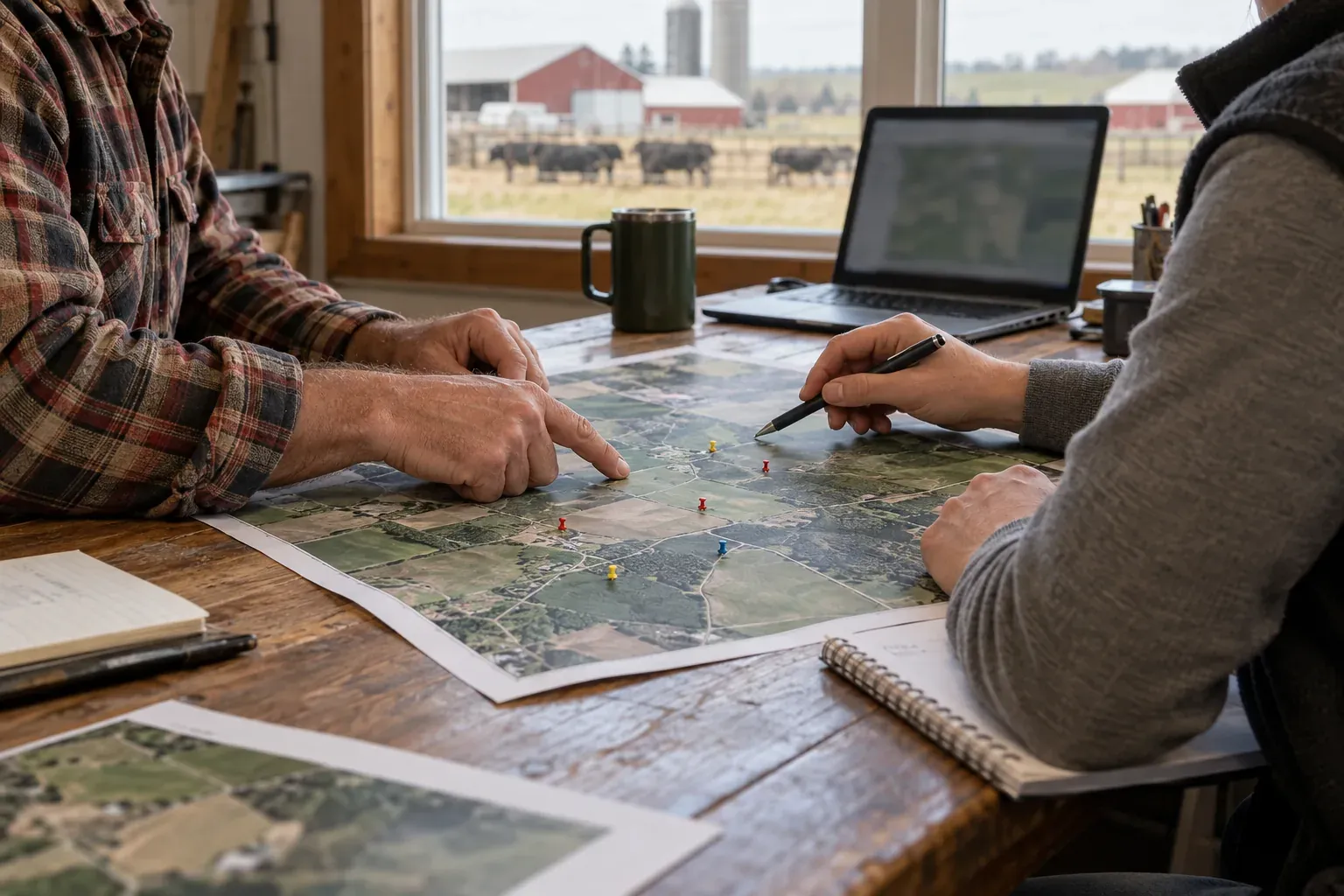
- Map your connectivity — Survey the property for gateway placement, identify power sources, and confirm internet backhaul availability. For a private LoRa network, a single gateway (a 5 km radius in open areas) covers most single-site operations.
- Establish baseline metrics — Document current estrus detection rates, disease treatment timing, mortality rates, and labor allocation. Without baseline data, you cannot measure improvement.
- Design response protocols — Define who receives alerts, how they are triaged, and what actions are taken at each alert level. Technology without protocol change delivers minimal value.
Phase 2: Pilot Deployment (1–3 months)
Start with a defined pilot group rather than full-herd deployment. The ideal pilot group is large enough to generate meaningful data (50–100 animals), represents a high-value use case (fresh cows, breeding heifers, or newly received feedlot cattle), and is managed by staff who will be early adopters and can provide feedback on alert quality and workflow integration.
During the pilot phase, the system establishes individual baselines (7–14 days), the team develops familiarity with the alert interface and response workflow, and initial outcomes are tracked against pre-deployment baselines. The pilot period is also when the team calibrates their trust in the system — learning which alerts require immediate response, which can be batched into daily reviews, and how the system's predictions correlate with their own observations.
Phase 3: High-Risk Group Expansion (3–6 months)
After the pilot validates the technology and workflow, expand to all high-risk and high-value animal groups:
- Dairy — fresh cows (first 60 DIM), breeding-eligible animals, and any animals with recent health history
- Beef breeding — all breeding females during the AI and natural service periods
- Feedlot — all newly received cattle during the high-risk first 45 days on feed
This phase typically generates the clearest ROI data because it covers the animal groups where monitoring has the highest per-animal value. Use the outcomes from this phase to build the business case for full-herd deployment.
Phase 4: Full-Herd Deployment
Full-herd monitoring provides the complete picture — not just detecting events in high-risk animals but establishing herd-wide behavioral baselines that enable group-level analytics, environmental response tracking, and the continuous improvement of management protocols based on comprehensive data.
Common Pitfalls and How to Avoid Them
Having observed PLF deployments across operations of all types and sizes, several recurring implementation mistakes stand out. Awareness of these pitfalls significantly improves the likelihood of a successful deployment.
Pitfall 1: Technology Without Protocol Change
The single most common failure mode is deploying monitoring technology without changing management workflows. A system that generates predictive health alerts is worthless if nobody checks the alerts before pen riding, or if the response to an alert is the same as the response to a visual observation made three days later. The value of early detection is only realized if early action follows. Define response protocols before deployment, train all relevant staff, and measure compliance.
Pitfall 2: Alert Fatigue
Systems that generate too many alerts — or alerts that aren't prioritized by severity — quickly lose staff trust and attention. This is particularly damaging because it undermines the entire value proposition: if staff stop responding to alerts, even high-confidence critical alerts go unactioned. Choose a platform with configurable alert thresholds and clear severity stratification, and resist the temptation to set sensitivity too high during the early deployment period.
Pitfall 3: Inadequate Baseline Period
The accuracy of any predictive monitoring system depends on the quality of individual animal baselines. Producers who expect immediate, high-accuracy results from day one are often disappointed. The baseline learning period (typically 7–14 days) is essential for the system to learn each animal's normal behavioral signature. Alerts generated during this period should be interpreted with caution, and the system should not be judged on its performance until baselines are established.
Pitfall 4: Ignoring Network Infrastructure
A monitoring system is only as reliable as its network connection. Operations that deploy sensors without proper network planning — relying on marginal cellular coverage or underestimating the range requirements for pasture-based systems — experience data gaps that undermine confidence in the technology. Invest in proper network infrastructure (ideally a private LoRa network) and validate coverage across all areas where animals will be monitored before full deployment.
Pitfall 5: Failing to Measure Outcomes
Operations that don't systematically track outcomes before and after deployment cannot quantify ROI, identify areas for improvement, or justify continued investment. At minimum, track estrus detection rates and conception timing, days to treatment from illness onset, first-treatment success rates, mortality rates, and labor hours allocated to observation activities. Without this data, the monitoring system becomes a cost center rather than a measurable investment with quantifiable returns.
The Future of Precision Livestock Farming
PLF technology is advancing rapidly, and several emerging applications are likely to become commercially significant within the next 3–5 years.
Predictive Genetics and Breeding
Continuous behavioral data collected over an animal's lifetime provides a phenotypic dataset that has never been available at scale before. When correlated with genomic information, this behavioral data can inform breeding decisions — identifying animals whose behavioral profiles predict superior mothering ability, feed efficiency, temperament, and disease resistance. This intersection of PLF and genomics represents a potential step-change in the rate of genetic improvement for functional traits that are difficult to measure through traditional evaluation programs.
Methane and Carbon Tracking
As agriculture faces increasing pressure to measure and reduce greenhouse gas emissions, PLF platforms are well positioned to incorporate methane estimation models. Research has demonstrated strong correlations between rumination patterns (already captured by accelerometer-based sensors) and individual methane emissions. Future PLF systems may provide individual-animal carbon accounting that supports emissions trading, sustainability certification, and premium market access programs.
Automated Regulatory Compliance
Animal welfare regulations are tightening across North America, the EU, and Australasia, with growing requirements for documented evidence of humane management practices. Continuous monitoring data provides an objective, timestamped record of animal behavior and management interventions that can serve as automated compliance documentation — reducing the administrative burden on producers while providing more robust evidence than periodic inspections or manual record-keeping.
AI-Driven Nutritional Optimization
By correlating feeding behavior data (time at bunk, feeding bout frequency, rumination patterns) with production outcomes and health events, AI systems can model the relationship between nutrition and performance at the individual animal level. This opens the door to precision feeding recommendations — adjusting ration formulations based on real-time herd behavioral feedback rather than periodic production data, potentially reducing feed costs while improving performance.
Getting Started: A Decision Framework
For producers evaluating precision livestock farming technology, the decision framework should address four fundamental questions:
- What is my primary value driver? — Operations focused on reproductive efficiency should prioritize estrus detection accuracy. Health-focused operations (feedlots, high-risk herds) should prioritize predictive health capabilities. Most operations benefit from both.
- Does the system work where my animals are? — Verify network coverage for all areas where animals will be monitored. Private network solutions avoid carrier dependency entirely.
- What is the total cost of ownership? — Compare subscription vs. capital purchase on a true lifecycle basis, including hardware replacement, software updates, and technology obsolescence risk.
- Am I prepared to change management workflows? — The most honest and important question. If the answer is no, the technology investment will underperform. If the answer is yes, the returns are well documented.
Conclusion
Precision Livestock Farming is not a future concept — it is a present-day reality deployed on thousands of commercial operations across North America, Europe, and Australasia. The technology has matured from simple step counters to AI-powered predictive platforms that continuously monitor every animal in the herd, and the economic models have shifted from prohibitive capital purchases to accessible subscription pricing.
For producers still managing by observation alone, the transition to data-driven operations represents both the largest technology decision and the largest efficiency opportunity available in modern livestock production. The operations that adopt precision monitoring are building a competitive advantage that compounds with every breeding season, every health event caught early, and every management decision informed by data rather than assumption.
Start Your Precision Livestock Farming Journey
Learn how Herdwize's complete platform — sensors, network, and AI analytics — can transform your operation.
Request a Platform Briefing