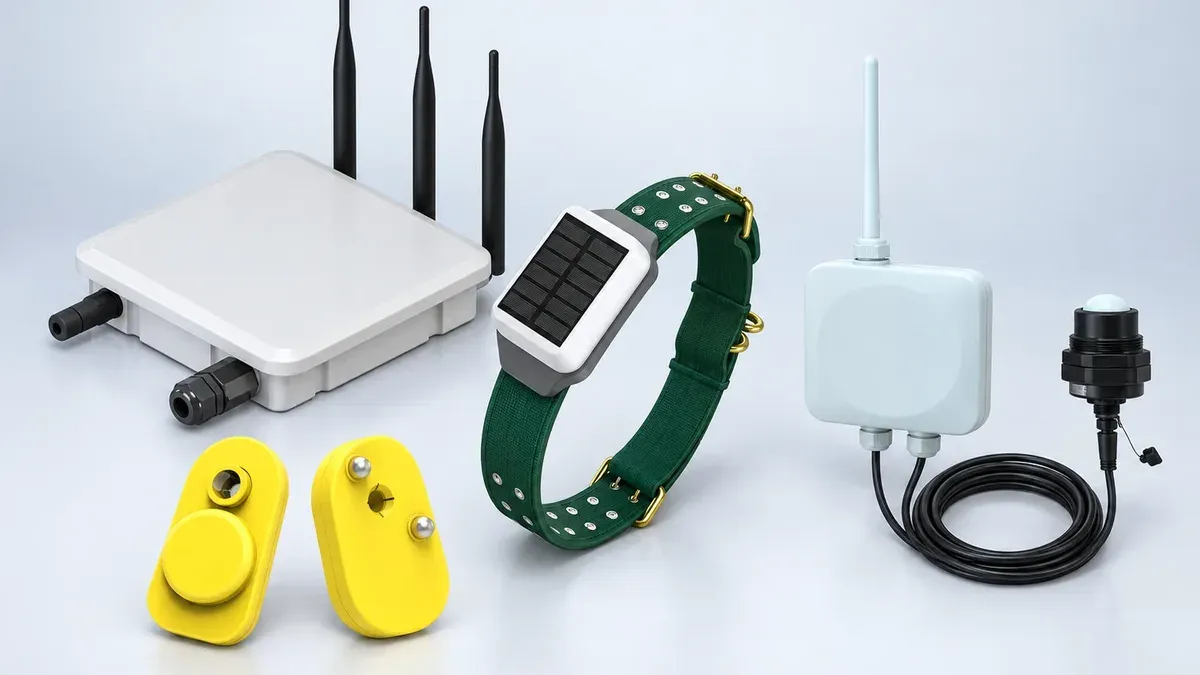
Key Takeaways
- The four primary cattle sensors — ear tags, collars, rumen boluses, and gate readers — each excel in different operational contexts, and no single form factor fits every operation
- Smart ear tags offer the best balance of metrics per gram — the Herdwize Smart Eartag captures body temperature and activity at just 9–12.5g with a 2–4 year battery life
- GPS collars are essential for extensive grazing operations where location tracking across thousands of acres justifies the higher per-unit cost
- Rumen boluses provide the most accurate core body temperature readings but cannot be repositioned or reused across animals
- Gate readers deliver high-accuracy identification at fixed chokepoints but cannot monitor animals continuously between reads
Cattle sensors are electronic devices attached to or ingested by livestock that continuously collect physiological, behavioral, and environmental data — transforming herd management from periodic visual observation into data-driven decision making. As precision livestock farming matures, the variety of available sensor form factors has expanded significantly, and choosing the right type for your operation is one of the most consequential technology decisions a producer can make.
This guide provides a detailed, objective comparison of the four primary cattle sensor types used in commercial operations today: ear tags, collars, rumen boluses, and gate readers. We examine what each sensor measures, how it performs in the field, what it costs, and — most importantly — which operations each type is best suited for.
Why Sensor Form Factor Matters
When evaluating cattle sensors, producers often focus on software dashboards and alert capabilities. Those matter, but the physical form factor of the sensor determines several constraints that no amount of software can overcome:
- What data can be captured — sensor placement on or inside the animal dictates which physiological signals are accessible
- Battery life — size and weight constraints limit battery capacity, which determines how long the sensor operates before replacement
- Animal welfare impact — weight, attachment method, and placement affect comfort, behavior, and regulatory compliance
- Operational cost — installation labor, replacement frequency, and reusability all vary by form factor
- Data frequency — continuous monitoring vs. point-in-time reads fundamentally changes what analytics are possible
Understanding these trade-offs is essential before investing in any monitoring technology platform. The wrong form factor for your operation type can render even the best analytics platform useless.
Cattle Sensors Compared: The Complete Breakdown
The following table compares all four cattle sensor form factors across the dimensions that matter most to commercial producers. This is the reference you need when evaluating vendors and planning deployments.
| Feature | Ear Tags | Collars | Rumen Boluses | Gate Readers |
|---|---|---|---|---|
| Form factor & weight | 9-40g, clipped to ear | 300-800g, neck-mounted | 100-200g capsule, orally administered | Fixed panel or wand, not animal-mounted |
| Metrics captured | Temperature and activity; some models add rumination and head position | GPS location, activity, grazing time, some models add rumination | Core body temperature, rumen pH, rumen motility | Animal ID, weight (with scale), passage time, count |
| Battery life | 2-5 years (button cell or thin-film) | 1-3 years (rechargeable, some solar-assisted) | 2-4 years (non-replaceable) | Mains-powered or 5+ years on battery |
| Durability / IP rating | IP67-IP68, ruggedized polymer housing | IP67 typical, exposed to mechanical stress | Fully sealed (internal to animal), acid-resistant | IP65-IP67, industrial steel/polymer enclosure |
| Data frequency | Continuous (periodic transmissions) | Continuous (GPS fix intervals vary: 1 min - 1 hr) | Continuous (every 5-15 min) | Event-based (only when animal passes reader) |
| Installation method | Standard ear tag applicator, <30 sec/animal | Manual neck fitting in chute, 1-2 min/animal | Oral bolus gun, requires trained operator | Fixed infrastructure installation at gates/chutes |
| Animal comfort | Excellent — minimal weight, familiar form factor | Good — requires proper sizing to prevent chafing | Excellent once settled — no external presence | N/A — no animal-mounted component |
| Cost per unit | $30-$80 | $100-$300 | $80-$150 (non-recoverable) | $2,000-$10,000 per read point |
| Connectivity | LoRa, BLE, or other proprietary RF | LoRa, cellular (4G), or satellite | UHF or proprietary RF (limited range from rumen) | Wired (Ethernet/RS485) or WiFi |
| Best use case | Individual health, fertility, and behavior monitoring at scale | Extensive grazing with GPS location and geofencing | Research, high-value breeding stock, acidosis monitoring | Automated sorting, weighing, and inventory at fixed points |
Smart Ear Tags: The Versatile Workhorse
Smart ear tags have become the most widely deployed cattle sensor form factor, and for good reason. By leveraging a familiar attachment method that producers have used for decades, electronic ear tags minimize animal handling stress while maximizing the range of data captured per gram of device weight.
Modern smart ear tags like the Herdwize Smart Eartag integrate a body-temperature sensor and a pedometer into a composite housing weighing just 9–12.5 grams. This enables continuous monitoring of body temperature and activity (step counts) — the core data streams behind Herdwize's estrus detection, health prediction, and calving alerts.
What Ear Tags Measure and Why It Matters
Some vendors' ear tags use a 3-axis accelerometer that captures movement patterns at high frequency, then classify these patterns into behavioral states: eating, ruminating, resting, walking, and high activity. Pedometer-based tags such as the Herdwize Smart Eartag count steps instead, tracking each animal's activity against its own baseline (rumination monitoring is on the Herdwize roadmap). Changes in these baselines — increased restlessness, reduced activity, a drop in rumination where it is measured — are early indicators of estrus, illness, calving onset, and stress.
Temperature sensing at the ear provides a proxy for core body temperature. While ear surface temperature is less precise than rumen temperature, it is sufficient for detecting the fever spikes associated with bovine respiratory disease (BRD) and other infections, typically flagging elevated temperatures 24-48 hours before clinical symptoms become visible.
Ear Tag Strengths
- Scalability: Ear tags are the easiest cattle sensors to deploy at herd scale — a crew can tag 200+ animals in a single handling session
- Multi-metric: A single device captures body temperature and activity, and some vendors' tags add rumination — the core signals for health and fertility monitoring
- Battery life: Low-power design gives the Herdwize Smart Eartag a 2–4 year battery life on a single button cell, sized to outlast the animal's time on the tag — no charging, maintenance, or battery replacement; tags are replaced only when animals turn over
- Animal comfort: At 9–12.5g, the Herdwize Smart Eartag adds negligible weight compared to standard visual ID tags
- Cost per data point: At $30-$80 per unit with two or more years of battery life, ear tags deliver the lowest cost per measurement across all cattle sensor types
Ear Tag Limitations
- No GPS: Standard ear tags lack GPS location capability — they report data to the nearest gateway but cannot pinpoint animal position
- Temperature accuracy: Ear surface temperature is affected by ambient conditions, making readings less precise than rumen-based sensors in extreme weather
- Tag loss: While uncommon with proper application (1-3% annual loss rate), tag loss means data loss for that animal until re-tagging
GPS Collars: Location Intelligence for Extensive Operations
GPS collars address the one capability that ear tags cannot provide: precise animal location. For ranching operations managing cattle across thousands of acres of rangeland, knowing where animals are — and where they are not — is a daily operational necessity that justifies the higher cost and complexity of collar-based cattle sensors.
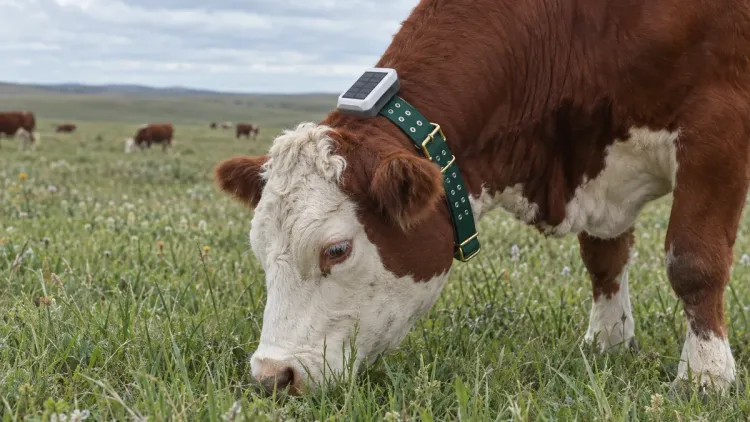
Herdwize GPS collars combine GPS positioning (1–2.5 m or 2.5–5 m accuracy, depending on model) with an integrated pedometer and a built-in solar panel that keeps them running continuously with at least 4 hours of daily sunlight, over a 5-year service life. Solar charging eliminates the collar retrieval and recharging cycle that plagues non-solar designs.
What Collars Measure
The primary data stream from a GPS collar is location — latitude/longitude coordinates at configurable intervals, typically every 1-60 minutes depending on the model, the operational use case, and desired battery life. This location data enables several critical management capabilities:
- Virtual fencing and geofencing: Instant alerts when animals breach defined boundaries, eliminating daily fence-riding
- Grazing distribution analysis: Heat maps showing pasture utilization, identifying overgrazing and underused areas
- Animal recovery: Locating stray or stolen animals across open rangeland
- Water point monitoring: Detecting whether animals are accessing water sources at normal frequency
Most GPS collars also include an accelerometer or pedometer for basic activity data; Herdwize collars use an integrated pedometer, and some models add temperature sensing. However, GPS collars are not designed to detect rumination patterns, which require sensors dedicated to measuring jaw movement.
Collar Strengths
- GPS location: The only cattle sensor form factor that provides continuous position tracking in extensive environments
- Geofencing: Automated boundary monitoring replaces labor-intensive fence checking on large properties
- Solar charging: Solar-assisted models extend operational life without manual intervention
- Reusability: Collars can be transferred between animals, reducing long-term cost for operations with regular turnover
Collar Limitations
- Cost: At $100-$300 per unit, collars cost 2-5x more than ear tags, limiting economic viability for large herds
- Weight and fit: Collars weighing 300-800g require proper sizing and periodic adjustment, especially on growing animals
- Mechanical vulnerability: Neck-mounted devices are exposed to rubbing on trees, fences, and feeders, leading to higher damage rates
- Limited health metrics: Collars capture less precise behavioral and physiological data than ear-mounted or internal sensors
- Not suitable for calves: Young animals grow too quickly for fixed-size collars, and the weight is proportionally too high
Rumen Boluses: Internal Precision for High-Value Stock
Rumen boluses represent a fundamentally different approach to cattle sensors. Rather than attaching a device to the exterior of the animal, a bolus is a sealed capsule administered orally that settles in the reticulum (the second stomach compartment), where it continuously measures core body temperature and, in some models, rumen pH and motility.
What Boluses Measure
The rumen environment provides access to data that no external sensor can match:
- Core body temperature: Measured directly from the rumen, bolus temperature readings are accurate to +/- 0.1 degrees C and unaffected by ambient temperature — the gold standard for fever detection and estrus-related temperature shifts
- Rumen pH: Critical for detecting subclinical acidosis (SARA), a condition that reduces feed efficiency by 5-15% and is nearly impossible to detect visually
- Rumen motility: Contraction frequency and intensity reflect digestive health and can indicate illness before other symptoms appear
Bolus Strengths
- Temperature accuracy: No external cattle sensor matches the precision and consistency of rumen-based temperature measurement
- Zero external presence: Once administered, the bolus has no visible presence and cannot be lost, damaged, or removed
- Acidosis detection: pH monitoring enables real-time detection of ration problems that erode feed efficiency
- Tamper-proof: Internal placement means no risk of theft, vandalism, or removal by animal behavior
Bolus Limitations
- Non-recoverable: When the animal is culled or sold, the bolus is lost — it cannot be reused, making the effective cost per animal-year higher
- Limited metrics: Boluses cannot measure activity, location, or surface-level behavioral patterns like rumination jaw movement
- Signal attenuation: RF signals from inside the rumen are significantly weakened by body tissue and fluid, limiting transmission range and requiring closer gateway placement
- Administration risk: Improper bolus administration can cause esophageal damage, requiring trained operators
- Regulatory considerations: Some markets have restrictions on ingestible electronics in food-producing animals
Gate Readers: Infrastructure-Based Identification
Gate readers (also called panel readers or race readers) take an entirely different approach from the other cattle sensor types. Rather than continuously monitoring each animal, gate readers identify and measure animals as they pass through fixed chokepoints — gates, races, chutes, water points, or feed stations.
What Gate Readers Capture
When an animal passes through a gate reader, the system captures:
- Electronic ID: Reads the animal's RFID (electronic identification) tag — typically a half-duplex (HDX) or full-duplex (FDX) tag operating at 134.2 kHz
- Weight: When integrated with a walk-over weighing platform, the reader captures live weight at each passage
- Passage time and frequency: How often each animal visits water points or feed stations, and at what times
- Automated sorting: Draft gates can be triggered to divert specific animals into designated pens based on ID, weight, or other criteria
Gate Reader Strengths
- No per-animal sensor cost: Gate readers work with standard RFID ear tags that cost $2-$5 each — the reader infrastructure is the investment, not the per-head hardware
- Automated sorting: Draft gates triggered by reader data eliminate the labor of manually sorting animals for treatment, sale, or pen moves
- Weight tracking: Integrated walk-over scales provide automated average daily gain (ADG) data without manual weighing sessions
- Unlimited battery life: Fixed infrastructure runs on mains power, with no battery constraints
- 100% read rates: Properly installed panel readers achieve near-perfect identification rates at controlled chokepoints
Gate Reader Limitations
- Point-in-time data only: Gate readers cannot monitor animals between reads — there is no continuous health, temperature, or behavioral data
- Fixed infrastructure: Readers cannot follow animals to pasture, limiting use to confined or semi-confined operations
- High upfront cost: A single read point with sorting gate costs $2,000-$10,000, and complex installations with multiple read points can exceed $50,000
- No health prediction: Without continuous monitoring, gate readers cannot detect the early behavioral and physiological changes that predict illness, estrus, or calving
- Dependent on animal movement: If an animal avoids a read point (sick animals often reduce water and feed visits), the system captures less data precisely when monitoring matters most
Choosing the Right Cattle Sensor for Your Operation
The best cattle sensor for your operation depends on your production system, management priorities, herd size, and the specific outcomes you need to improve. Here is how each sensor type maps to common operation types:
Dairy Operations
Dairy herds benefit most from ear tag sensors deployed across the milking herd. The combination of estrus detection, health monitoring, and rumination tracking addresses the three highest-value use cases in dairy: reproductive efficiency, early disease detection, and feed management. Because dairy cattle pass through the parlor 2-3 times daily, gate readers with automated sorting provide a valuable complementary layer for identification, drafting, and walk-over weighing.
Beef Feedlot Operations
In feedlots, ear tags are the clear choice for individual animal monitoring. BRD is the single largest health cost in feedlot operations, and continuous temperature and activity monitoring through ear tags enables detection 48-72 hours before pen riders can visually identify sick animals. Gate readers at pen entry/exit points and processing chutes add automated identification and sorting. The confined environment means GPS is unnecessary.
Extensive Ranch / Cow-Calf Operations
Ranch operations managing cattle across large grazing areas need GPS collars for location intelligence — finding animals, monitoring boundary compliance, and tracking grazing distribution. For ranches that also want health and fertility monitoring on their breeding herd, a combination strategy works well: collars on the cow herd for location plus ear tags on high-value breeding stock for health and estrus detection. Learn more about how activity monitoring compares across platforms.
Breeding and Genetics Programs
High-value breeding operations often justify the premium cost of rumen boluses for precise temperature monitoring during estrus synchronization programs, where the temperature accuracy advantage over external sensors directly impacts conception rates. Combined with ear tag sensors for behavioral monitoring and gate readers for automated identification and weight tracking, breeding programs can build the most comprehensive individual animal data profiles in the industry.
Connectivity: The Hidden Differentiator
Regardless of which cattle sensors you choose, the connectivity layer determines whether data actually reaches your dashboard. Devices on a private LoRa network, such as Herdwize's LoRa collars and farm sensors, benefit from a 5 km gateway radius in open areas, low power draw, and zero per-device data costs. Cellular-connected sensors offer simpler deployment but carry recurring SIM costs and shorter battery life due to higher transmission power requirements.
Herdwize's LoRa Gateway collects data from the Herdwize ear tags, collars, and sensors within its range and forwards it to the cloud over a wired Ethernet connection, drawing less than 4 W in an IP66 outdoor enclosure. Larger or hilly properties simply add gateways on high ground as the operation grows.
Total Cost of Ownership: Beyond Unit Price
When comparing cattle sensor costs, the per-unit purchase price is just the starting point. Total cost of ownership must account for battery replacement or recharging, tag loss rates, installation labor, connectivity fees, and reusability across animal lifecycles.
| Cost Factor (5-year, 500 head) | Ear Tags | Collars | Boluses |
|---|---|---|---|
| Hardware cost | $15,000-$40,000 | $50,000-$150,000 | $40,000-$75,000 |
| Replacement over 5 years | $1,500-$4,000 (tag loss) | $10,000-$30,000 (damage/battery) | $20,000-$37,500 (animal turnover) |
| Network infrastructure | $1,000-$4,000 (LoRa gateways) | $1,000-$4,000 (LoRa) or $30,000+ (cellular) | $2,000-$6,000 (base stations) |
| Installation labor | Low (standard tagging) | Medium (collar fitting) | High (trained operator required) |
| Estimated 5-year total | $17,500-$48,000 | $61,000-$184,000 | $62,000-$118,500 |
Gate readers are excluded from this per-head comparison because their cost structure is fundamentally different — the investment is per read point, not per animal, making them more economical as herd size increases. For a 500-head feedlot with two read points, total gate reader infrastructure cost is typically $10,000-$25,000 over five years.
Frequently Asked Questions
Can I use multiple cattle sensor types together?
How do cattle sensors handle extreme weather conditions?
What is the difference between RFID ear tags and smart ear tags?
Do rumen boluses affect animal health or meat quality?
How quickly can cattle sensors be deployed across a large herd?
Not Sure Which Cattle Sensor Fits Your Operation?
Our team can assess your operation type, herd size, and management priorities to recommend the right sensor strategy — whether that is ear tags, collars, or a combination approach.
Request a Platform Briefing