Key Takeaways
- Over 60% of agricultural land in North America has unreliable or no cellular coverage, making cellular-dependent IoT solutions impractical for most farms
- A single Herdwize LoRa gateway covers a 5 km radius in open areas, and additional gateways extend coverage as the operation grows
- Private LoRa networks cost 80–90% less per device than cellular IoT over a 5-year lifecycle
- Low-power design delivers multi-year battery life in the field — 5 years for LoRa water and soil sensors, 2–4 years for ear tags, and solar power with a 5-year service life for GPS collars — eliminating annual battery replacement
- Farm-owned networks provide complete data sovereignty with zero dependency on telecom carriers or monthly data plans
The promise of IoT in agriculture is compelling: continuous monitoring of livestock, soil, weather, and equipment generating actionable data that improves decisions and reduces costs. But the reality of deploying IoT on a working farm is fundamentally different from deploying it in a factory, a warehouse, or a city. Farms are large, remote, and often beyond the reach of the cellular networks that most IoT platforms depend on.
This article examines why cellular IoT falls short for agricultural applications, how LoRa long-range radio technology solves the connectivity challenge, and why private farm-level networks represent the most practical and economical approach for commercial livestock operations.
The Farm Connectivity Problem
Before evaluating any specific technology, it's important to understand the unique connectivity challenges that agriculture presents — challenges that are fundamentally different from those in urban or industrial environments.
Cellular Dead Zones Are the Norm, Not the Exception
Telecom carriers build infrastructure where population density justifies the investment. Rural agricultural regions, by definition, do not meet that threshold. According to the USDA and CRTC data, over 60% of agricultural land in North America lacks reliable 4G/LTE coverage, and 5G deployment in rural areas remains negligible and is unlikely to change materially in the next decade.
Even in areas with nominal cellular coverage, real-world signal quality on farms is often inadequate for reliable IoT operation. Terrain features, tree lines, metal buildings, and the simple fact that cattle spend time in valleys and hollows where signal is weakest all contribute to connectivity gaps that look fine on a coverage map but fail in practice.
Satellite: Too Expensive, Too Power-Hungry
Satellite connectivity has improved dramatically with new low-earth orbit (LEO) constellations, but it remains fundamentally unsuitable for livestock IoT at scale. The cost per device for satellite connectivity ranges from $5–$15 per month, which is economically prohibitive when monitoring hundreds or thousands of individual animals. Additionally, satellite transceivers require significantly more power than terrestrial alternatives, reducing battery life in sensor devices from years to months.
Wi-Fi: Wrong Tool for the Job
Standard Wi-Fi (802.11) was designed for high-bandwidth, short-range applications. Its range of 50–100 meters outdoors makes it entirely impractical for covering the hectares or square miles of a typical livestock operation. Mesh Wi-Fi can extend range but adds complexity, cost, and power consumption that don't make sense for the small data packets that sensor devices transmit.
What Is LoRa and How Does It Work?
LoRa (short for Long Range) is a radio technology specifically designed for IoT applications that require long range, low power consumption, and low data rates. It operates in unlicensed ISM radio spectrum and uses a spread-spectrum modulation technique that enables communication over distances that would be impossible with conventional wireless protocols. Herdwize runs LoRa with its own private protocol between its collars and farm sensors and the Herdwize LoRa gateway, so the network belongs to the farm rather than to a carrier or a shared public service.
The Physics of Long Range
LoRa modulation works by spreading the signal across a wide frequency band, trading data rate for range and noise immunity. The result is a signal that can be received at power levels well below the noise floor — a property that enables reliable communication over several kilometers in open rural terrain, with shorter range where hills, tree lines, and buildings get in the way.
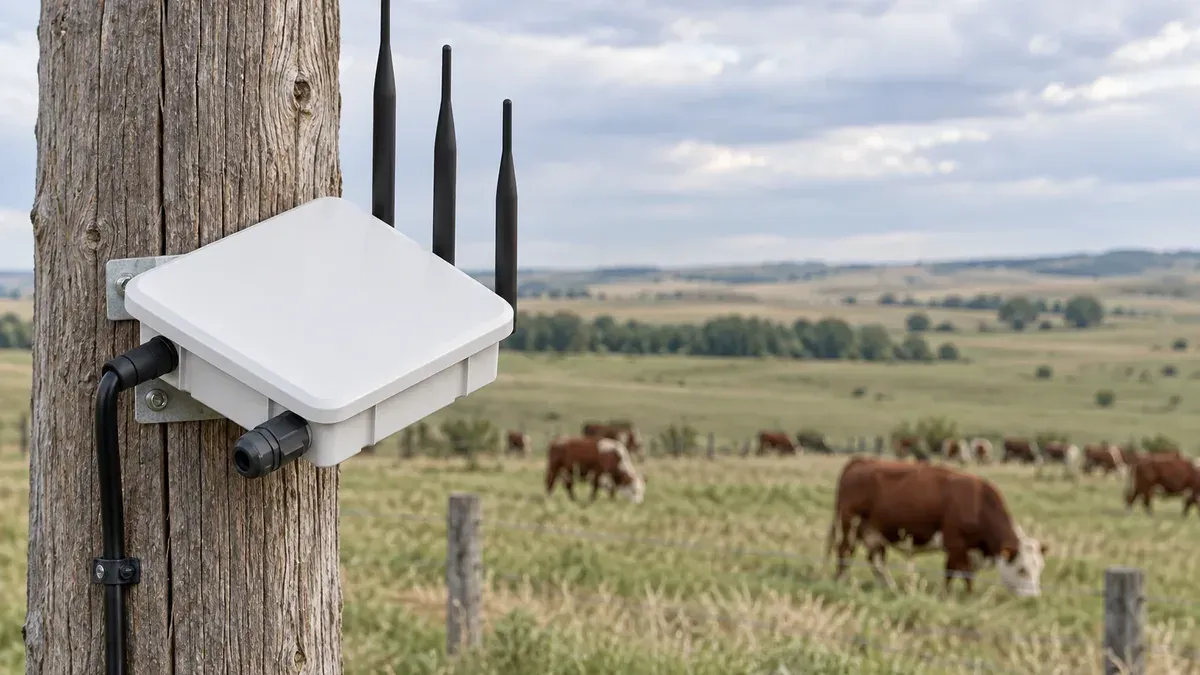
For agricultural applications, this range characteristic is transformative. A single Herdwize LoRa gateway mounted on a barn roof, grain leg, or elevated pole covers a 5 km radius in open areas — approximately 7,850 hectares (19,400 acres), enough for the core of most single-site operations. Larger or hilly properties simply add gateways on high ground.
Ultra-Low Power Consumption
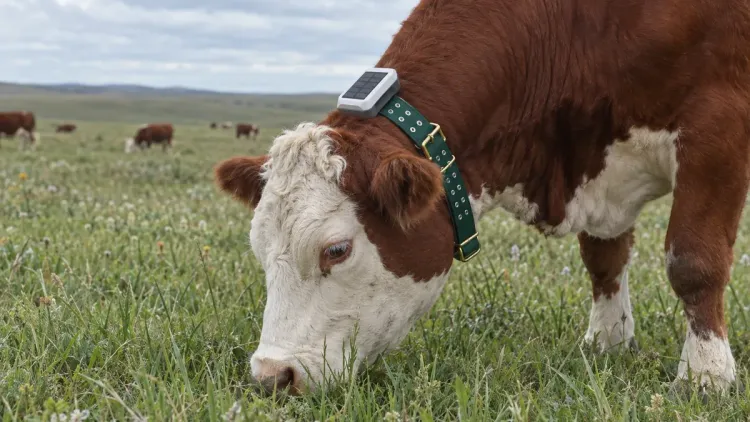
LoRa end devices (the collars and sensors in the field) consume microwatts of power during sleep mode and milliwatts during brief transmission bursts. Herdwize LoRa water-level and soil sensors run for 5 years on a single battery, and LoRa GPS collars use built-in solar panels to run continuously with at least 4 hours of daily sunlight over a 5-year service life. Herdwize ear tags, which report through the Herdwize gateway, last 2–4 years on a button cell. That is far better than cellular IoT devices, which typically require recharging or battery replacement every 3–12 months.
For livestock applications, battery life is not a convenience feature — it is a practical necessity. Re-tagging animals to replace batteries is labor-intensive, stressful for the animals, and operationally disruptive. That is why the Herdwize ear tag battery is sized to outlast the animal's time on the tag: tags are replaced only when animals turn over, never for batteries, and solar-powered collars take routine battery swaps off the job list.
Network Architecture
A Herdwize private LoRa network has a simple, three-part architecture:
- End devices — the collars and farm sensors (LoRa GPS collars, stock-tank water-level sensors, soil probes) that collect and transmit data
- Herdwize LoRa gateway — receives transmissions from devices within its range over the private LoRa protocol and forwards them through a wired Ethernet connection to the farm's internet service
- Herdwize platform — the cloud platform where device data is stored and processed, and where health alerts and dashboards are generated
The topology is a simple star: each device talks directly to the gateway, with no carrier network in between. A gateway serves the collars and sensors within its range, and when the herd or the property grows, additional gateways can be added to extend coverage to new pastures and sites.
Private Network vs. Cellular IoT: A Direct Comparison
| Factor | Cellular IoT (4G/LTE-M) | Private LoRa Network |
|---|---|---|
| Rural coverage | Dependent on carrier infrastructure | Self-contained — works wherever you install a gateway |
| Range per base station | 1–5 km (rural cell tower) | 5 km radius in open areas (per gateway) |
| Battery life (field sensor) | 3–12 months | 5 years (water and soil sensors) |
| Device cost | $15–$40 (cellular module) | <$5 (LoRa radio) |
| Monthly data cost | $1–$5 per device | $0 (farm-owned network) |
| 5-year cost per device | $75–$340 | $10–$30 |
| Carrier dependency | Complete | None |
| Data sovereignty | Data routes through carrier network | Data travels over the farm-owned network |
| Adding devices | New data plan per device | No per-device data plan |
The Cost Advantage Compounds at Scale
The economic difference between cellular and a private LoRa network becomes dramatic at livestock-operation scale. Consider a 1,000-head operation:
Cellular IoT (5-year total)
- Device modules: $25,000
- Data plans: $36,000–$180,000
- Battery replacements: $15,000+
- Total: $76,000–$220,000
Private LoRa Network (5-year total)
- Gateway hardware (1–2 gateways): $1,500–$3,000
- Device radios: $5,000
- Data plans: $0
- Battery replacements: $0
- Total: $6,500–$8,000
The 10–30x cost advantage of a private LoRa network is the primary reason that virtually all successful large-scale livestock IoT deployments use some form of private LPWAN (Low Power Wide Area Network) technology rather than cellular connectivity. And because Herdwize runs the whole network, reporting intervals can be set to each herd's needs — as often as every minute on GC010 collars — without per-message data charges.
Data Sovereignty and Operational Independence
Beyond cost and coverage, private farm networks offer a strategic advantage that is often overlooked: complete operational independence. When your monitoring system depends on a cellular carrier, you are vulnerable to:
- Network outages — carrier infrastructure failures can knock out your entire monitoring system with no recourse
- Coverage changes — carriers can decommission towers, change frequency allocations, or sunset network technologies (as happened with 2G and 3G shutdowns that bricked millions of IoT devices)
- Price increases — monthly data costs are set by the carrier and can change at renewal
- Data routing — your animal health data traverses the carrier's network and potentially their cloud infrastructure, raising data privacy and sovereignty questions
A private LoRa network removes these dependencies for the devices in the field. The farm owns the radio infrastructure, controls the data path from device to gateway, and does not need a carrier to reach its animals. The gateway requires only a power source and a wired Ethernet connection to the farm's existing internet service — one shared connection for the whole network, far cheaper than per-device cellular or satellite plans.
Deployment: How to Set Up a Private Farm LoRa Network
Deploying a private LoRa network on a farm is significantly simpler than most producers expect. The process typically involves four steps:
1. Site Survey and Gateway Placement
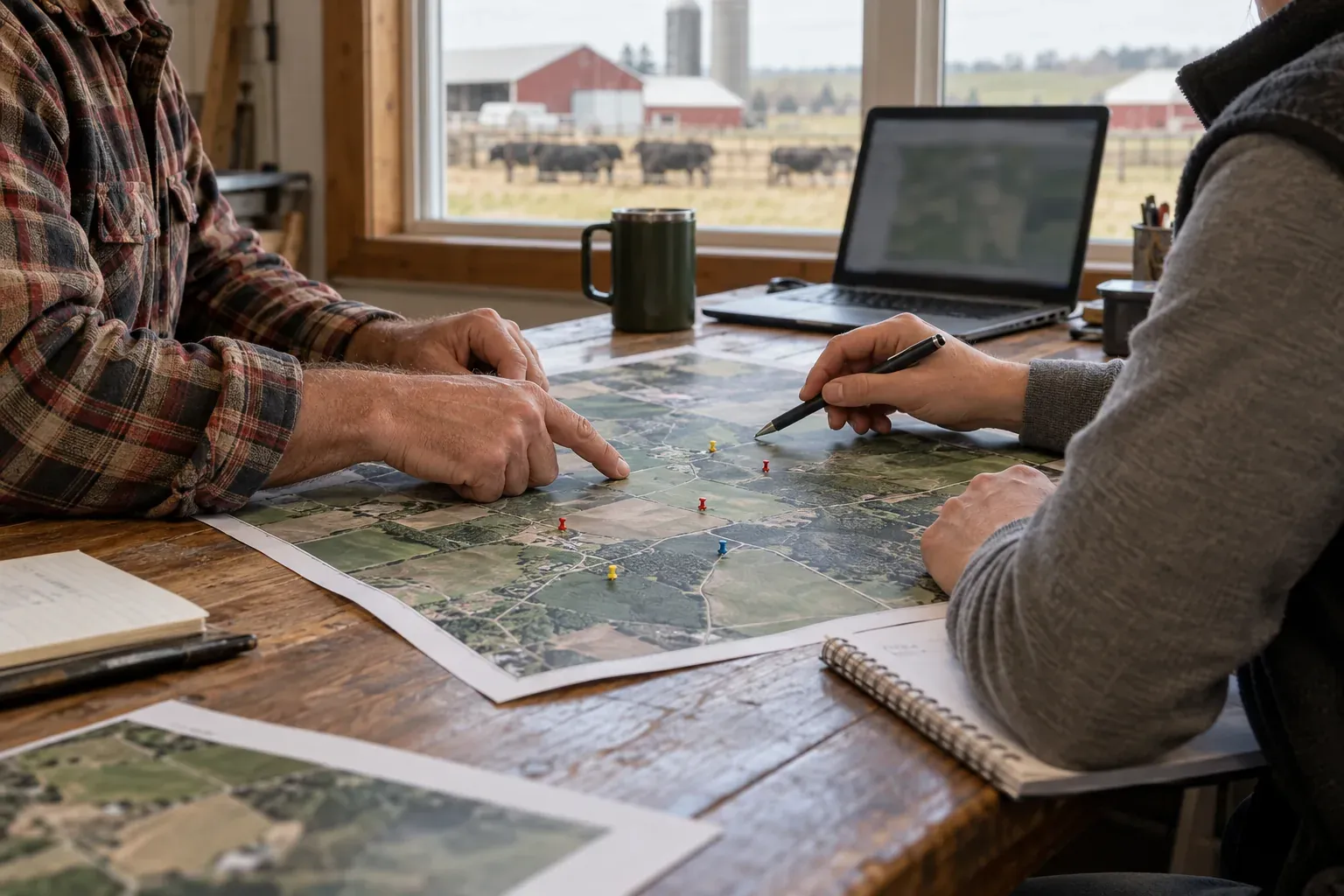
The most important decision is gateway placement. Higher is better — mounting the gateway at 8–15 meters elevation (on a barn peak, grain leg, or dedicated pole) maximizes the line-of-sight coverage radius. Each Herdwize LoRa gateway covers a 5 km radius in open areas; hills, tree lines, and buildings reduce that range. Compact single-site operations are often covered by one gateway, while larger properties, operations spanning multiple sites, or hilly terrain add gateways on high ground for full coverage.
2. Gateway Installation
The Herdwize LoRa gateway is a compact unit (222 × 136 × 80 mm) in an IP66-rated waterproof housing, built to operate from −20 °C to 70 °C. Installation requires mounting the unit, providing power through its DC adapter (the gateway draws less than 4 W), and running an Ethernet cable to the farm's internet connection. Most installations take 2–4 hours.
3. Device Registration and Tagging
Each sensor device (eartag, collar, or environmental sensor) is registered on the Herdwize platform and associated with the specific animal or location it monitors. For livestock, tagging is typically integrated with existing chute-side processing events to minimize additional animal handling.
4. Network Validation
After deployment, the system runs a validation period to confirm that all devices are communicating reliably from all areas of the operation. Coverage maps generated from actual device transmissions identify any dead spots, which can be addressed by gateway repositioning or the addition of a secondary gateway if needed.
Beyond Livestock: Other Agricultural LoRa Applications
Once a private LoRa network is operational on a farm, it becomes a platform for multiple applications beyond livestock monitoring — some available from Herdwize today, others typical of what long-range, low-power farm networks can support:
- Soil moisture and salinity monitoring — Herdwize soil sensors report volumetric water content and electrical conductivity (EC) for precision irrigation and fertilization, running 5 years on one battery
- Weather stations — distributed micro-climate monitoring can support frost alerts, spray timing, and crop management
- Water system monitoring — Herdwize radar water-level sensors report stock tank levels to help prevent livestock water supply failures
- Equipment tracking — GPS-enabled LoRa tags on trailers, ATVs, and implements can support asset management
- Grain bin monitoring — temperature and humidity sensors can help prevent spoilage and detect hot spots
- Fence monitoring — voltage and break detection on electric fencing systems
This multi-application potential means the network investment amortizes across the entire farm operation, not just the livestock monitoring use case. The marginal cost of adding another Herdwize sensor to an existing private LoRa network is minimal — just the cost of the sensor itself, with no additional data plan.
Conclusion
The connectivity gap in agriculture is real, but it is a solvable problem. Private LoRa networks provide the range, battery life, and cost structure that cellular IoT cannot match for farm applications. They eliminate carrier dependency, provide data sovereignty, and create a platform that serves not just livestock monitoring but water and soil monitoring across the farm as well.
For livestock producers evaluating monitoring solutions, network infrastructure should be one of the first questions asked. A system that depends on cellular coverage will only work where the carrier has built infrastructure. A system with its own private network works wherever you put the gateway — which means it works on your farm, regardless of where your farm is.
Build Your Farm's Private Network
Herdwize deploys a complete private LoRa network, built around the Herdwize LoRa gateway, as part of every monitoring subscription — no upfront network costs.
Request a Platform Briefing