Key Takeaways
- A Herdwize LoRa gateway covers a 5 km radius in open areas with zero recurring cellular data costs — critical for operations in areas with poor cellular coverage
- Cellular IoT devices consume 100-1,000x more power per transmission than LoRa, reducing battery life from years to months
- Each gateway serves every LoRa collar and sensor in its range, and more gateways can be added as the operation grows, making the per-device network cost negligible at scale
- Private LoRa networks give producers full data sovereignty — no third-party cellular carrier involved in data transmission
- For livestock operations, private LoRa's combination of range, battery life, and cost makes it the clear technical winner over cellular and WiFi
Connectivity is the invisible infrastructure that makes or breaks a livestock monitoring system. Without reliable data transmission from the sensor on the animal to the analytics platform, even the most sophisticated algorithms are useless. Yet connectivity is often the least understood component when producers evaluate monitoring solutions.
This article provides a detailed technical comparison of private LoRa farm networks and cellular IoT for livestock monitoring — the two primary connectivity options for commercial operations — covering range, cost, power consumption, reliability, and data control.
Why Connectivity Matters More Than the Sensor
A common mistake when evaluating livestock monitoring systems is focusing exclusively on sensor capabilities while treating connectivity as an afterthought. In practice, the network layer determines several critical operational parameters:
- Coverage area — which animals can actually be monitored
- Battery life — how often you need to re-tag animals
- Ongoing cost — recurring cellular data fees can exceed the sensor cost within a year
- Reliability — whether alerts arrive when you need them
- Data ownership — who controls the data path between animal and dashboard
Private LoRa: Purpose-Built for Rural IoT
LoRa (short for Long Range) is a spread-spectrum radio technology designed for IoT applications that need long range, low power consumption, and only small amounts of data per transmission. It operates on unlicensed ISM spectrum, so no carrier license, SIM card, or subscription is involved. Herdwize runs LoRa radio with its own private protocol between its devices and the Herdwize LoRa gateway — a network built for exactly the kind of deployment that livestock monitoring requires.
How a Private LoRa Network Works on a Farm
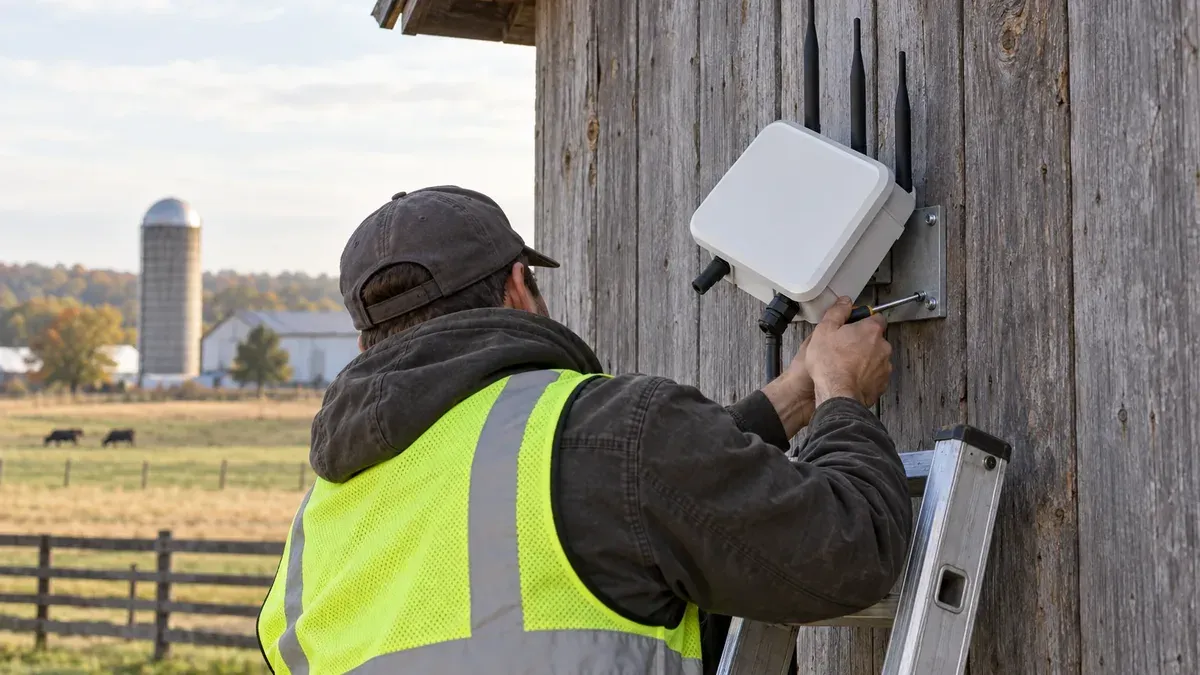
In a typical Herdwize deployment, one or more Herdwize LoRa gateways are installed at elevated positions on the property — barn rooftops, grain bins, or dedicated poles. Each gateway covers a 5 km radius in open areas; hills, tree lines, and buildings reduce that range, so larger or hilly properties add gateways on high ground.
Every LoRa GPS collar and farm sensor on the property transmits data packets to the nearest gateway using LoRa radio signals, and Smart Eartags report through the same Herdwize gateway. The gateway forwards these transmissions to the cloud platform over its wired Ethernet connection. Critically, only the gateway needs internet connectivity — the devices in the field never need a SIM card or a data plan.
Key Private LoRa Advantages
- Range: 5 km radius per gateway in open areas — enough for many single-property operations with 1-2 gateways, with additional gateways on high ground for larger or hilly properties
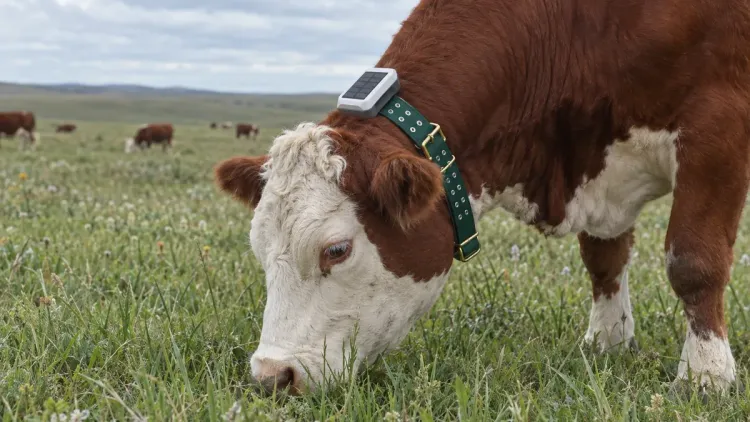
- Battery life: LoRa's low-power radio enables years of operation in the field — Herdwize water level and soil sensors are rated for 5 years, and LoRa GPS collars, with a 5-year service life, run continuously on solar power with at least 4 hours of daily sunlight
- Scalability: Each gateway serves the collars and sensors within its range, and more gateways can be added as the herd and the property grow
- Zero recurring data costs: LoRa operates on unlicensed spectrum with no per-device SIM cards or cellular data plans. Because Herdwize runs the whole network, reporting intervals can be set to each herd's needs — as often as every minute on GC010 collars — without per-message data charges
- Data sovereignty: Data travels directly from sensor to your gateway to the cloud — no third-party cellular carrier in the path
Cellular IoT: Familiar but Flawed for Livestock
Cellular IoT (using LTE-M, NB-IoT, or legacy 2G/3G networks) leverages existing mobile network infrastructure to transmit sensor data. This approach has the advantage of using established infrastructure — but that advantage comes with significant trade-offs for livestock monitoring.
The Rural Coverage Problem
Cellular coverage maps look impressive until you overlay them with actual livestock operations. According to CRTC coverage data, approximately 15% of Canada's land area has reliable cellular coverage. In Western Canada's ranching regions — where many of the largest operations are located — coverage gaps are the norm, not the exception.
Even in areas that show coverage on carrier maps, real-world signal strength at ground level (where cattle are) can be insufficient for reliable data transmission. Buildings, terrain, tree lines, and weather conditions all degrade cellular signals — and unlike a carrier tower many kilometres away, a private LoRa gateway can be placed on high ground on your own property, right where the herd grazes.
Power Consumption: The Battery Killer
The most critical disadvantage of cellular IoT for livestock sensors is power consumption. Cellular transmission requires significantly more energy than LoRa:
For a device attached to an animal's ear for years at a time, battery life isn't a minor specification — it's the difference between a viable product and an operational nightmare. Re-tagging animals every 6-12 months adds labor, stress, and cost that can negate the value of the monitoring system itself.
Per-Device Costs Add Up
Every cellular IoT device requires a SIM card and a data plan. Even at discounted IoT rates of $1-$3 per device per month, these costs accumulate:
- 500-head operation: $6,000-$18,000 per year in cellular data costs alone
- 1,000-head operation: $12,000-$36,000 per year
- Over 5 years: $30,000-$180,000 in pure connectivity costs
By contrast, an on-farm LoRa gateway costs $500-$2,000 as a one-time purchase and covers every LoRa device within its 5 km open-area radius with zero per-device data fees. With one or two gateways, the total 5-year network cost for a 500-head operation is typically $1,000-$4,000 versus $30,000-$90,000 for cellular.
WiFi: Not a Realistic Option
WiFi is sometimes mentioned as a connectivity option for livestock monitoring, but it fails on every dimension that matters for farm deployment:
- Range: 50-100 meters maximum, requiring dozens of access points for even modest coverage
- Power: WiFi transmission power consumption is even higher than cellular
- Infrastructure: Requires extensive wired backhaul across the property
- Interference: 2.4 GHz spectrum is congested and poorly suited to outdoor environments with moisture
WiFi may have a role for in-barn fixed-position sensors (e.g., milk meters, weighing systems), but it is fundamentally unsuitable for animal-mounted mobile sensors.
Head-to-Head Comparison
| Factor | Private LoRa | Cellular IoT | WiFi |
|---|---|---|---|
| Coverage per base station | 5 km radius (open areas) | Carrier-dependent | 50-100 m |
| Battery life (battery-powered sensors) | 5 years (water & soil sensors) | 3-12 months | Days-weeks |
| Per-device data cost | $0 | $1-3/month | $0 (but high infra cost) |
| SIM card per device | None | Required | None |
| Rural coverage | Excellent (self-deployed) | Poor-to-none in many areas | N/A |
| Data sovereignty | Full — producer-owned network | Carrier-routed | Local |
| 5-year cost (500 head) | $1,000-$4,000 | $30,000-$90,000 | $50,000+ (infrastructure) |
| Internet connection needed | Gateway only (Ethernet) | Every device (carrier network) | Every access point |
On-Farm Infrastructure: The Gateway Advantage
A private LoRa deployment adds something cellular systems cannot match: the radio network itself sits on your property. Because data is aggregated at the on-farm gateway, the link between each animal and the gateway never depends on a carrier tower — only the gateway's own internet connection does.
The Herdwize LoRa gateway is built for farm conditions: an IP66 waterproof ABS enclosure, an operating range of −20 °C to 70 °C, and a power draw of less than 4 W. It connects to existing farm internet over Ethernet, so the reliability of the whole network rests on one wired connection you control rather than on the cellular signal in every pasture. That matters for operations in remote areas where mobile service is weak or intermittent.
Cellular devices, by contrast, are dependent on real-time carrier connectivity. If the cellular network is down — due to weather, tower maintenance, or capacity limitations — data and alerts are delayed or lost.
Deployment Considerations
Site Assessment
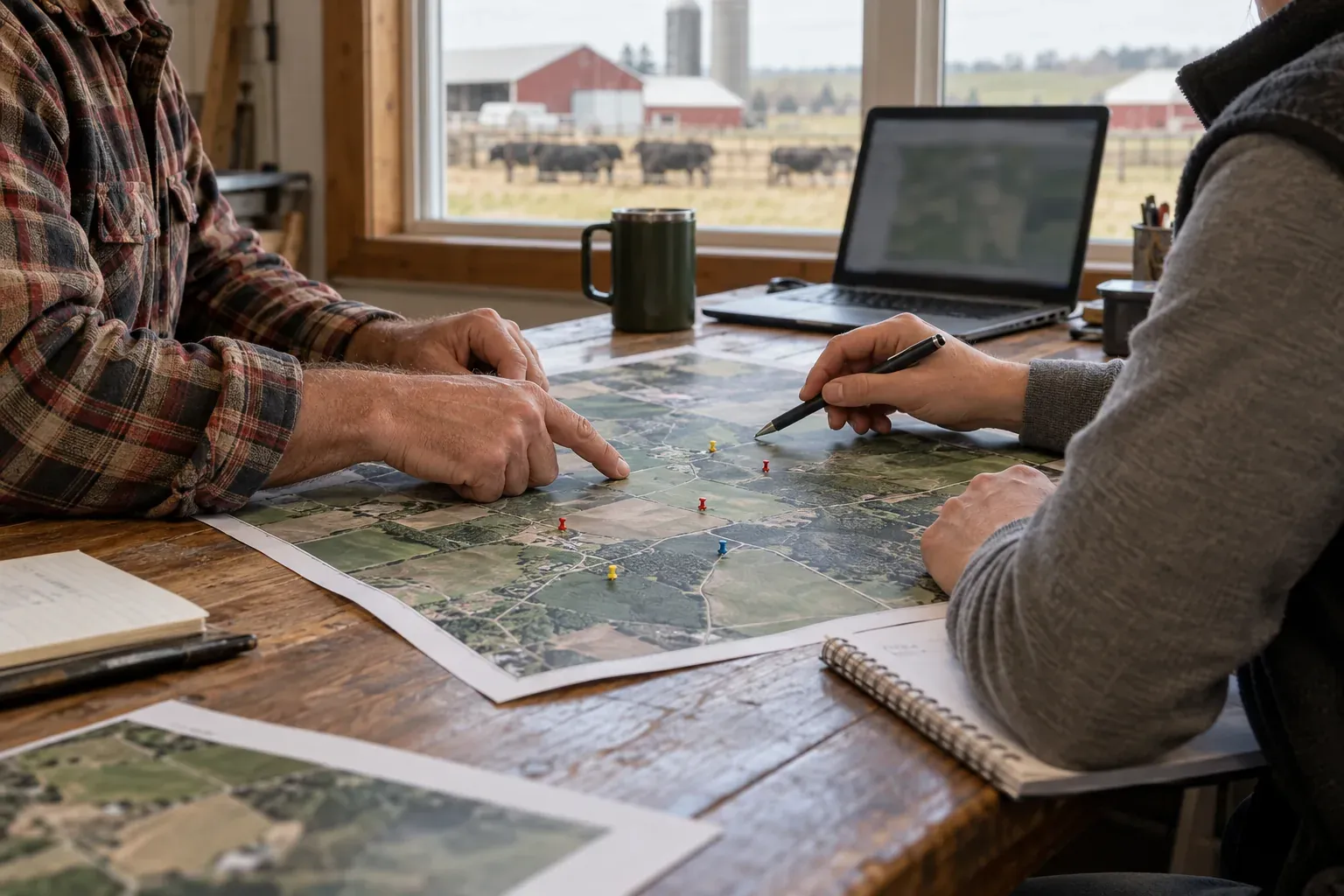
Before any deployment, a coverage assessment should be performed to determine gateway placement. Each Herdwize gateway covers a 5 km radius in open areas, less where hills, tree lines, or buildings block the signal. For many single-site operations, 1-2 gateways provide complete coverage; large multi-property ranches add more gateways on high ground, each reporting to the platform over its own internet connection. The assessment considers terrain, building locations, available internet connections, and the working area of the herd throughout the year.
Backhaul Options
The gateway itself needs internet connectivity to sync with the cloud platform. The Herdwize LoRa gateway connects over wired Ethernet, typically to the existing farm internet at the farmhouse, barn, or shop. For remote pastures where running a connection to a gateway is impractical, Herdwize's 4G GPS collars (GC08 and GC09) report directly over the cellular network without a gateway. The key point: on the private LoRa network, only the gateway needs an internet connection — not every animal.
Scalability
Adding animals to a private LoRa network is as simple as fitting their devices — no SIM provisioning, no carrier activation, no per-device data plan. When the herd moves beyond existing coverage, another gateway extends the network. This makes seasonal scaling (adding/removing animals from monitored groups) operationally trivial.
Conclusion
For commercial livestock monitoring, private LoRa networks deliver a decisive advantage over cellular IoT in every dimension that matters: range, battery life, cost, reliability, and data control. The technology was designed for exactly this kind of rural, large-area, high-device-count deployment.
The one scenario where cellular IoT may be preferable is for operations that need to monitor a very small number of high-value animals (<20) across extremely large distances (100+ km) where deploying gateways is impractical — the case Herdwize's 4G collars are built for. For the vast majority of commercial operations, a private LoRa network is the clear technical and economic choice.
Want to See Private LoRa Coverage for Your Property?
Request a free site assessment to see how Herdwize's private network would cover your operation.
Request Site Assessment